PROJECT
KREATIVITAS EVOLUSIONAL
Metodologi kreatif yang belajar dari evolusi biologis. Diadopsi oleh 70+ perusahaan dan universitas, pemenang Penghargaan Yamamoto Shichihei. Diterjemahkan ke dalam bahasa Mandarin, Korea, Indonesia, menyebar secara global.
HOW
Mensistematisasi pendidikan kreativitas menggunakan evolusi biologis.
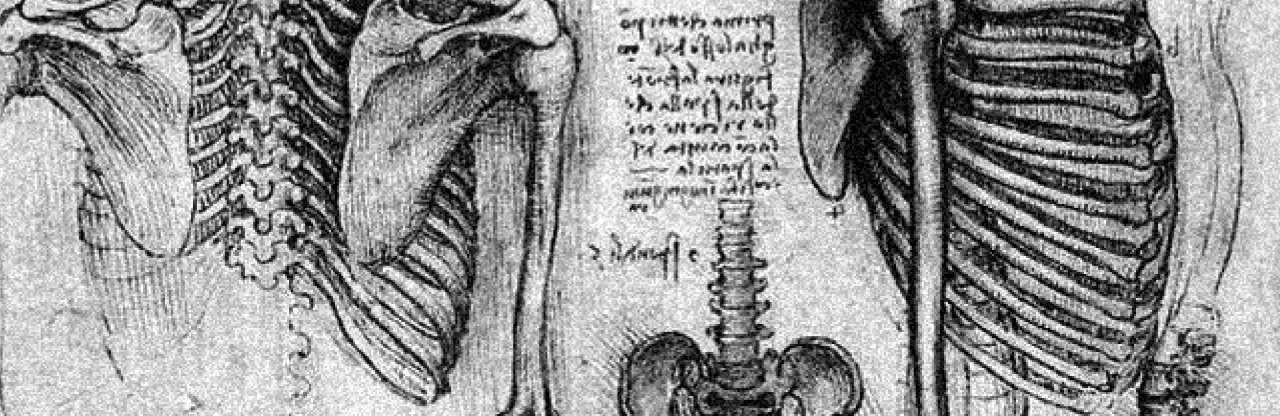
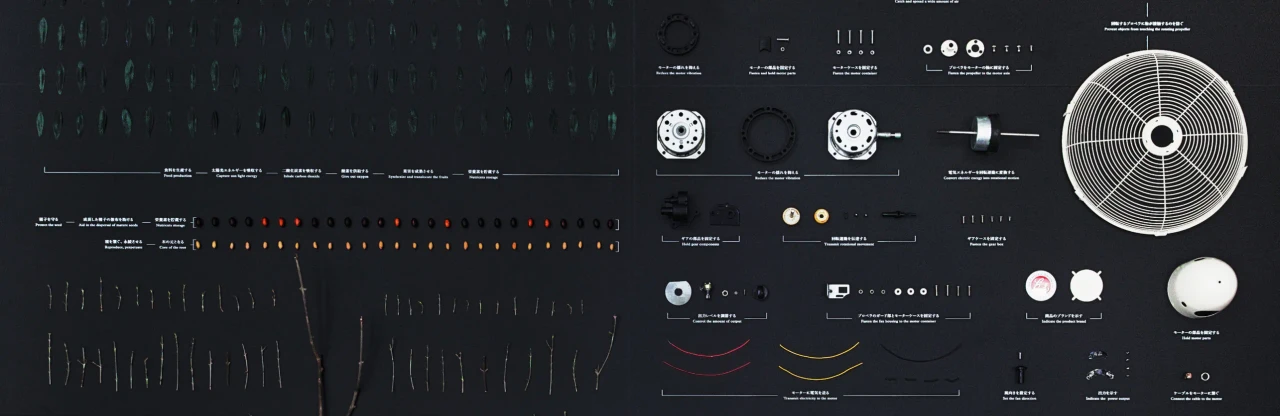
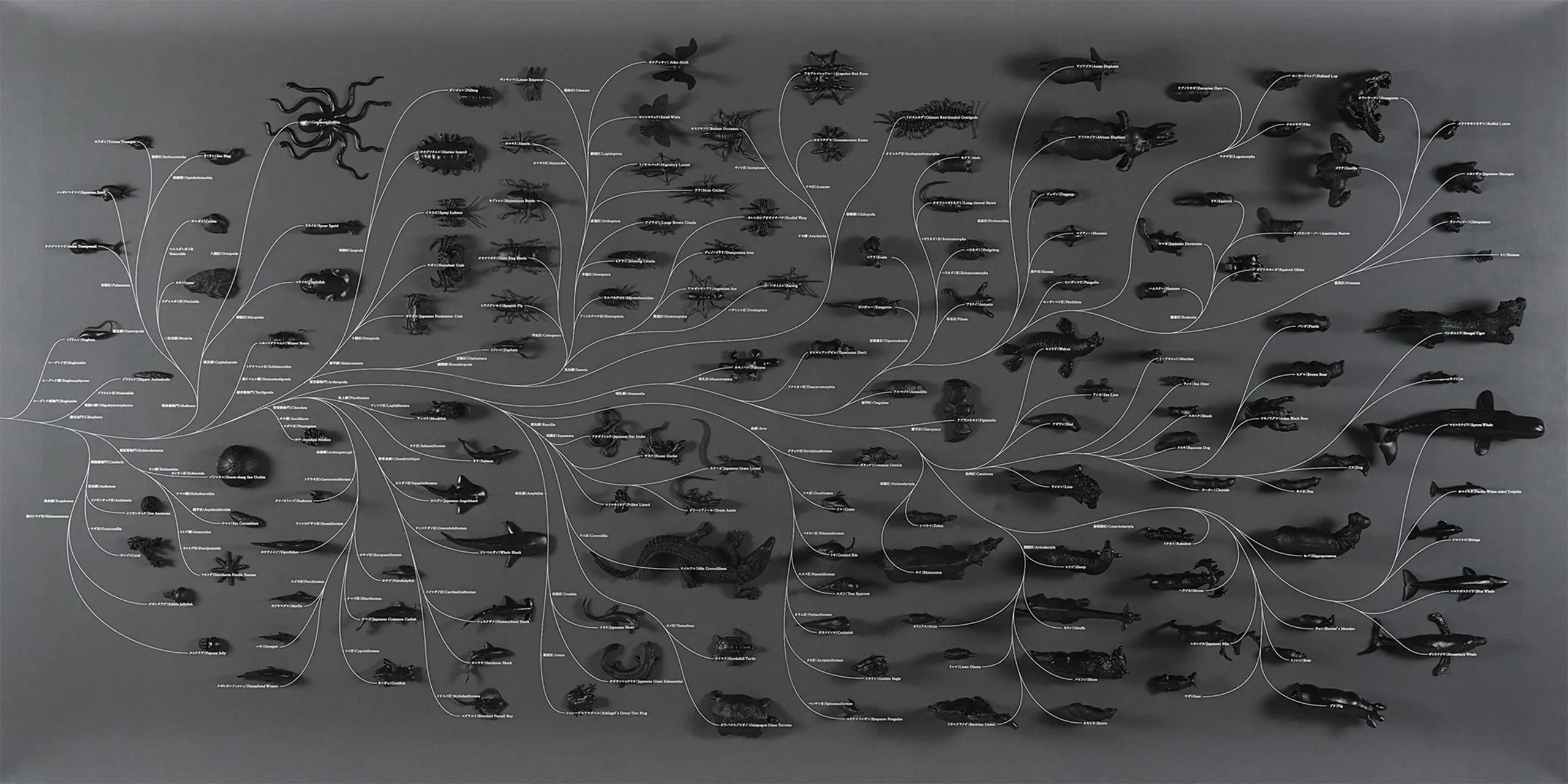
Kreativitas manusia sangat istimewa sehingga dapat disebut sebagai fenomena paranormal di dunia alami. Di antara puluhan juta spesies dalam sejarah kehidupan di Bumi selama 3,8 miliar tahun, tidak ada spesies lain yang menunjukkan tingkat kreativitas seperti kita. Karena kita manusia juga merupakan bagian dari alam, kreativitas kita juga harus dianggap sebagai fenomena alami.
Sementara itu, ketika kita melihat bentuk-bentuk di alam, kita mungkin berpikir bahwa alam bahkan lebih kreatif daripada manusia. Mengapa demikian?
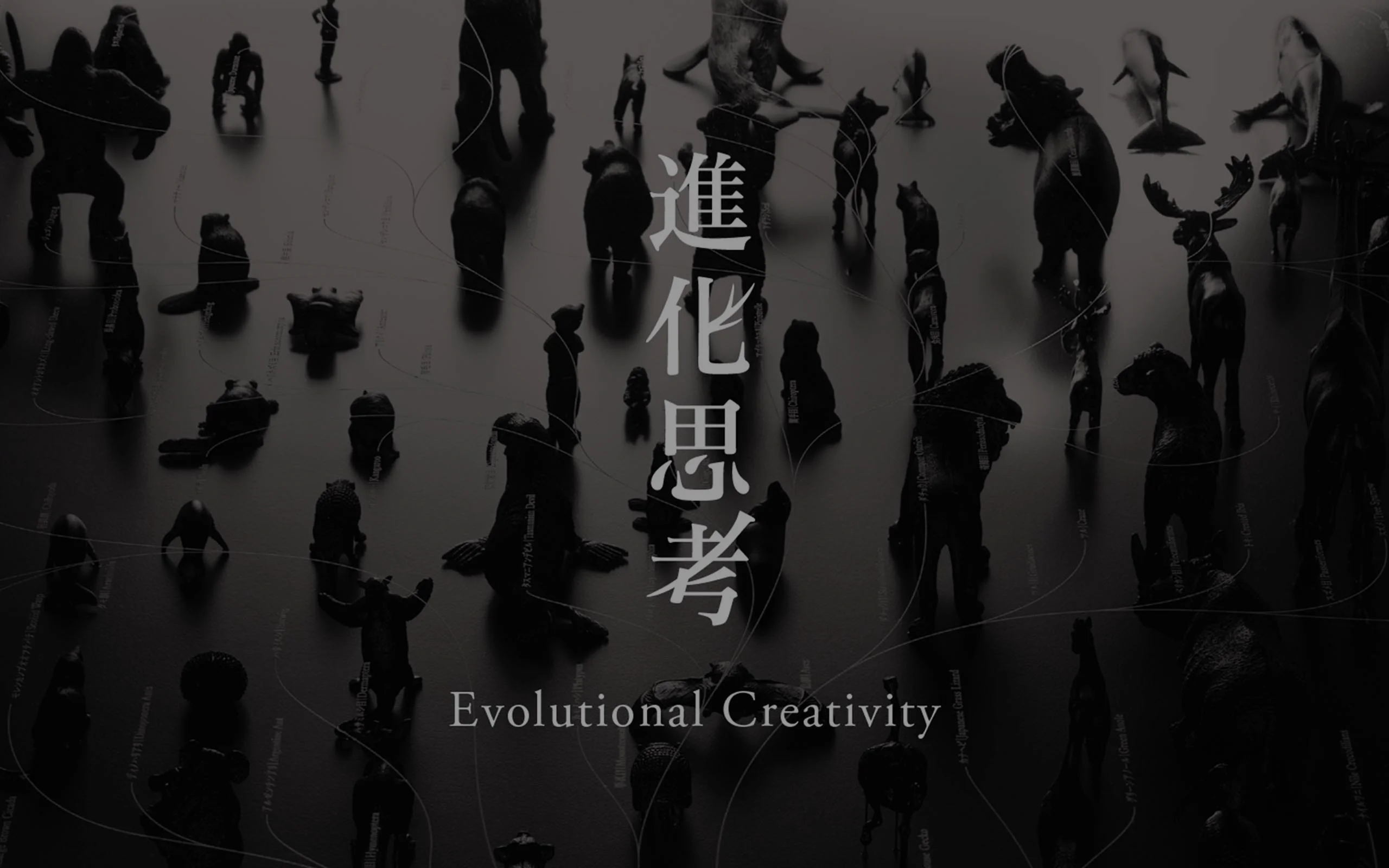
Dari perspektif ini, Eisuke Tachikawa, kepala NOSIGNER, berpikir bahwa kreativitas manusia adalah fenomena yang mirip dengan evolusi makhluk hidup. Dia terus berusaha menyusun struktur kreativitas berdasarkan evolusi alami. Dengan demikian dia menemukan Evolutional Creativity, sebuah metode berpikir kreatif yang tersistematis yang menerapkan cara kerja evolusi makhluk hidup pada desain dan inovasi.
Makhluk hidup berevolusi melalui mutasi yang terjadi secara kebetulan dan seleksi yang terjadi karena keharusan akibat faktor lingkungan dan kondisi lainnya. Kedua proses ini berulang secara genetik selama beberapa generasi.
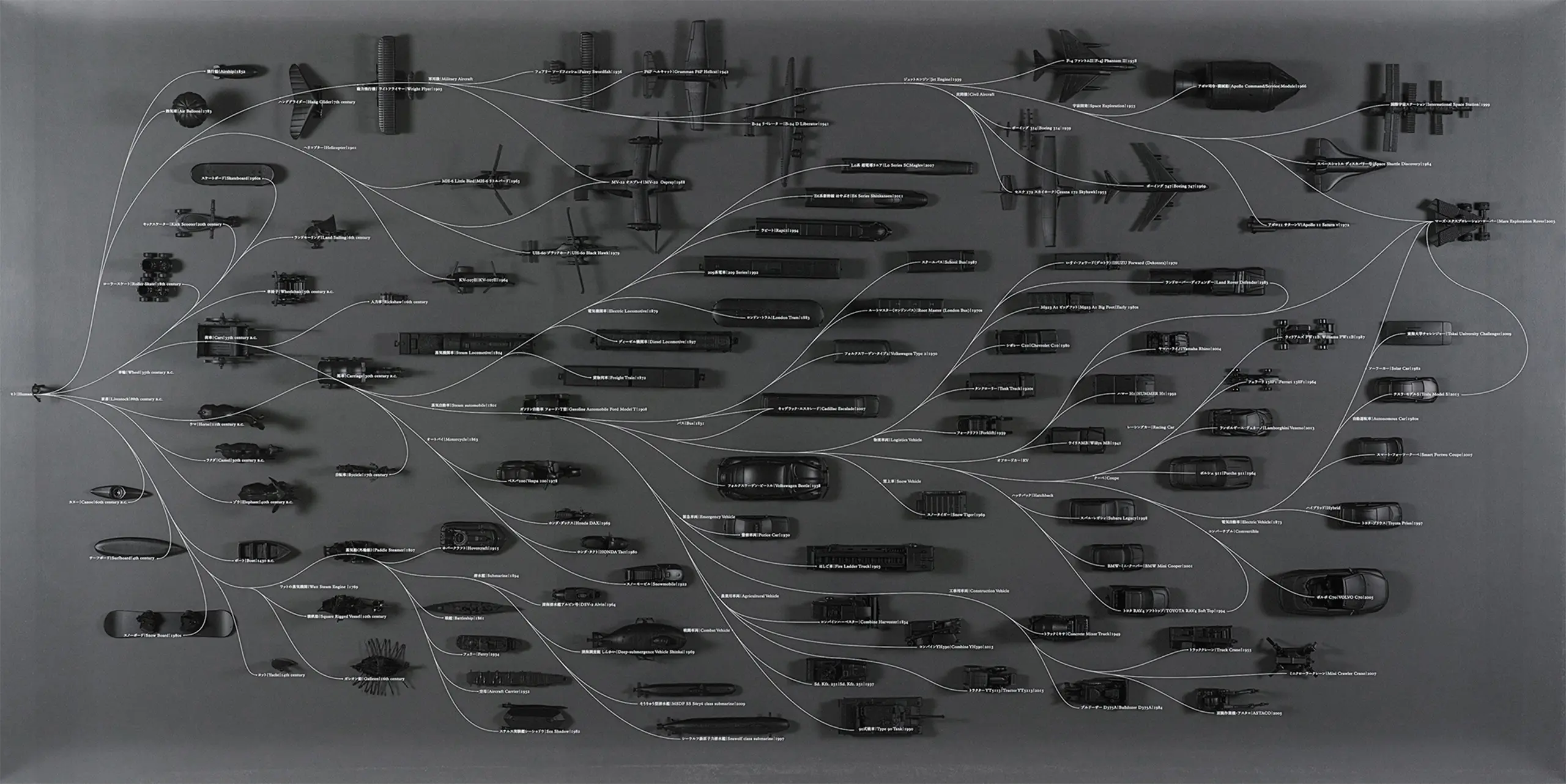
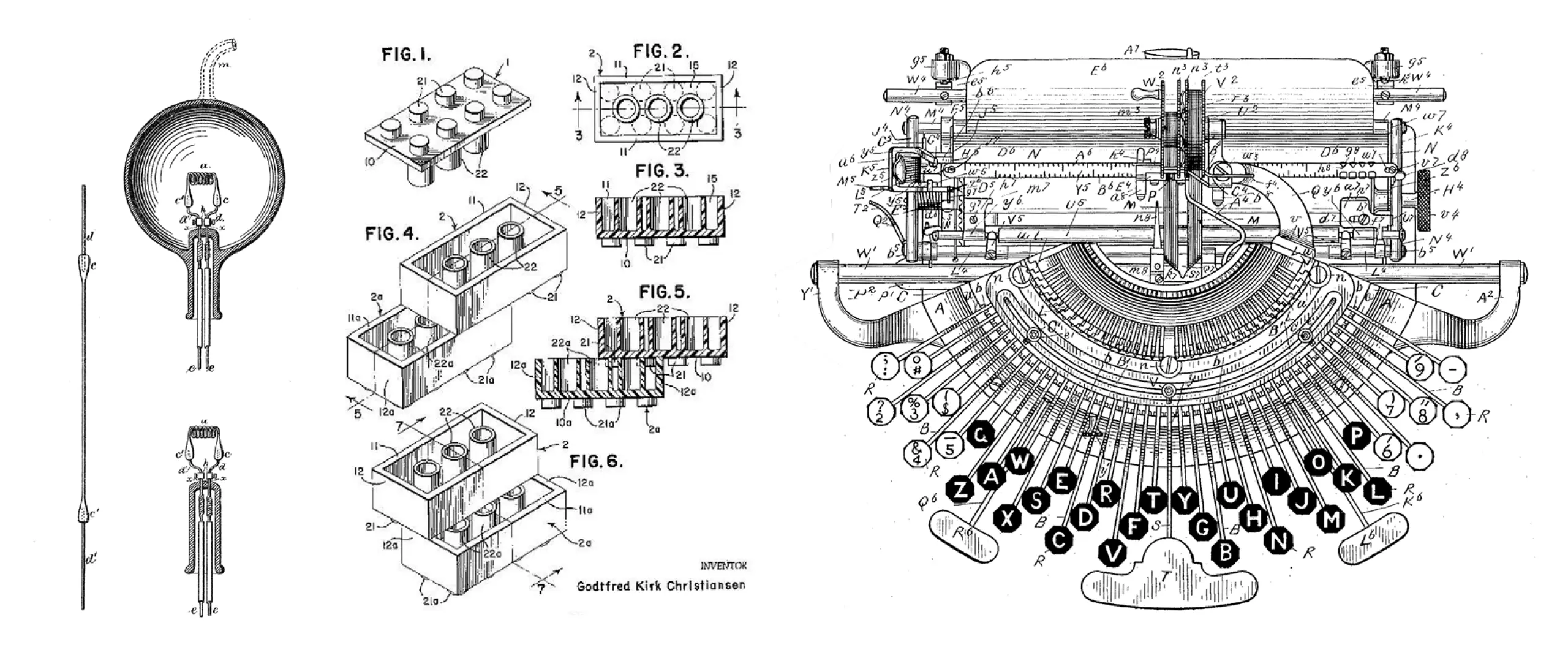
Jika kreativitas kita bekerja dengan cara yang sama, maka banyak penemuan dan inovasi umat manusia yang telah merevolusi dunia dapat dikaitkan dengan proses-proses yang bergantian ini yang disebabkan oleh kebetulan dan keharusan. Tidak ada niat sadar dalam proses kebetulan maupun keharusan. Kedua proses tersebut hanya bergantian untuk mendekatkan diri pada adaptasi yang optimal.
Kreativitas adalah sesuatu yang terjadi secara otonom tanpa bergantung pada niat sadar sang pencipta. Berdasarkan ide ini, Evolutional Creativity adalah proses bergantian antara ide-ide Mutasi yang lahir dari kebetulan yang gila dan tidak konvensional dan ide-ide Selektif yang lahir dari keharusan untuk beradaptasi dengan kondisi saat ini. Proses kreativitas yang bergantian ini berlangsung selama beberapa generasi.

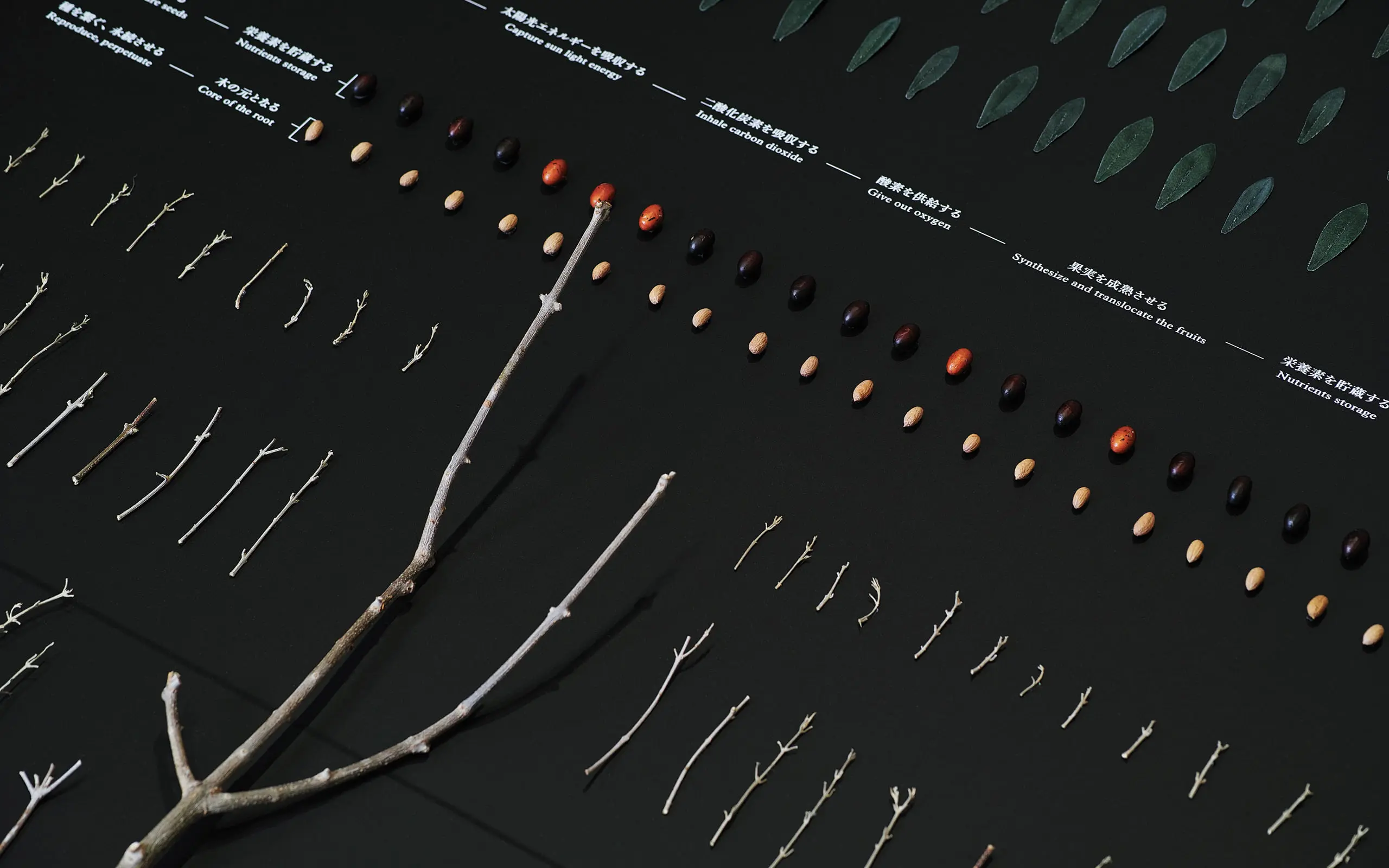
Tachikawa telah mempelajari hubungan antara desain dan bahasa, dan dia percaya bahwa sumber kreativitas manusia berasal dari bahasa. Dan kunci evolusi makhluk hidup adalah mutasi DNA yang sangat mirip dengan bahasa.
Kesalahan penyalinan DNA dapat disamakan dengan kesalahan pengucapan dan kesalahan mendengar bahasa. Berdasarkan asumsi ini, Tachikawa berteori bahwa evolusi dan kreativitas menghasilkan pola mutasi yang serupa.
Pola serupa yang ditemukan dalam evolusi makhluk hidup juga terlihat dalam berbagai penemuan dan budaya manusia. Evolutional Creativity menerapkan pola-pola serupa ini pada proses kreatif. Kesalahan yang menghasilkan ide-ide baru dikategorikan menjadi sembilan jenis.
Dengan menggunakan sembilan pola mutasi Variate, Disappear, Integrate, Reverse, Separate, Substitute, Assimilate, Transit, dan Proliferate sebagai alat dari kotak alat, kita dapat menghasilkan sejumlah besar kesalahan kebetulan untuk menciptakan banyak ide dalam waktu singkat. Ini adalah ide-ide yang bermutasi.
Jadi bagaimana kita memilih ide yang baik dari jenis-jenis kesalahan ini? Di alam, kita dapat mengamati bagaimana makhluk hidup membuat pilihan untuk beradaptasi dengan lingkungannya. Jika kita belajar dari pendekatan ilmuwan alam yang telah lama disempurnakan untuk mengamati alam, kita mungkin dapat memilih ide-ide yang adaptif.
Saat mempelajari berbagai metode observasi dalam ilmu pengetahuan alam, Tachikawa memperhatikan bahwa hanya ada empat perspektif yang mencakup waktu dan ruang. Masing-masing adalah sistem observasi biologis yang mapan.
Empat perspektif tersebut adalah Anatomi untuk memahami bagian internal, Ekosistem untuk memahami lingkungan eksternal, Lineage untuk memahami perkembangan silsilah, dan Prediksi untuk merenungkan masa depan dengan dua pendekatan Forecast dan Backcast. Dia mensistematiskan empat metode Adaptif ini dan menamakannya Spatial-Temporal Learning. Dengan menganalisis kondisi melalui keempat perspektif yang mencakup waktu dan ruang ini, kita dapat memahami bagaimana masyarakat terpaksa membuat pilihan yang tidak dapat dihindari. Kita kemudian dapat melawannya dengan memilih ide-ide yang solid.
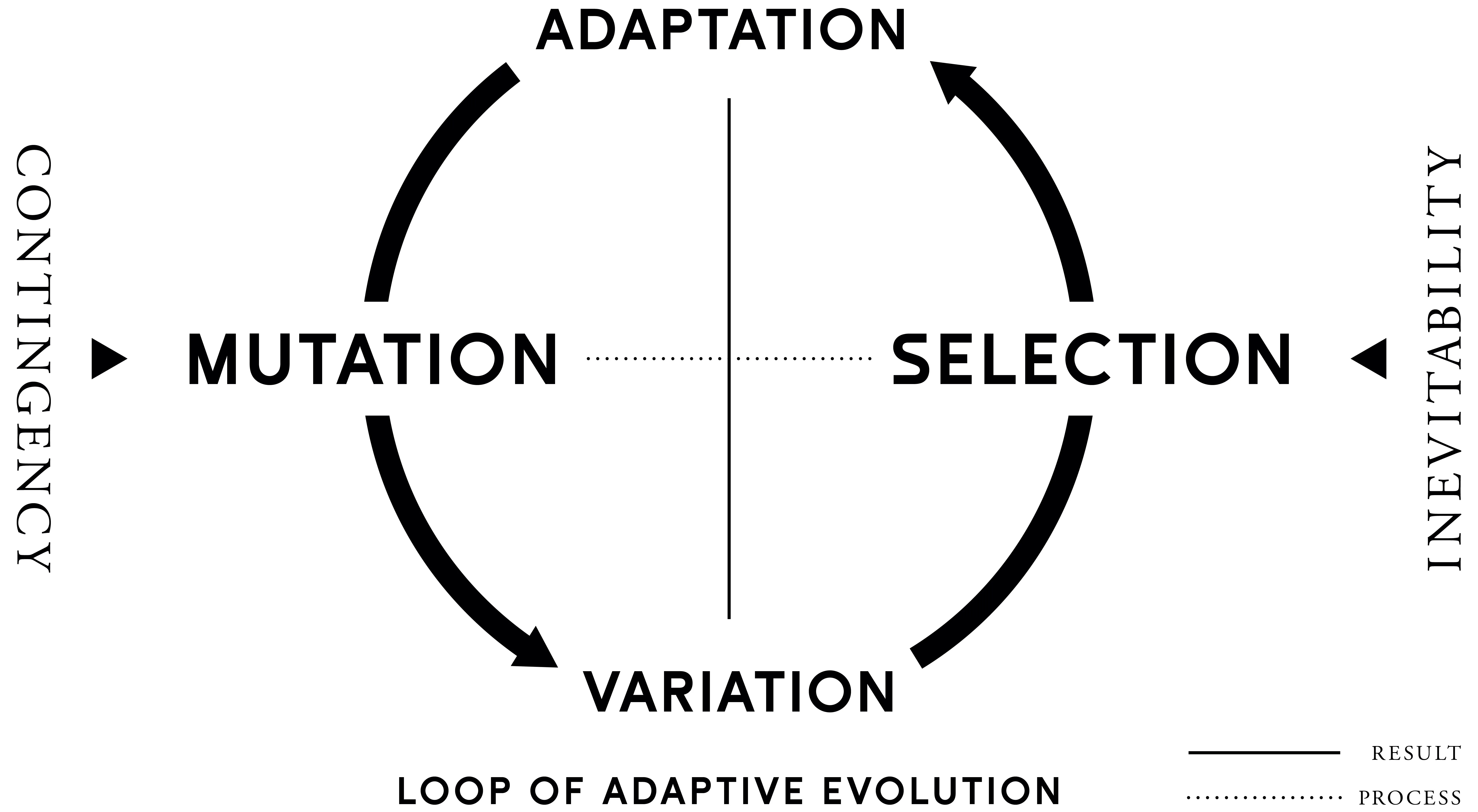
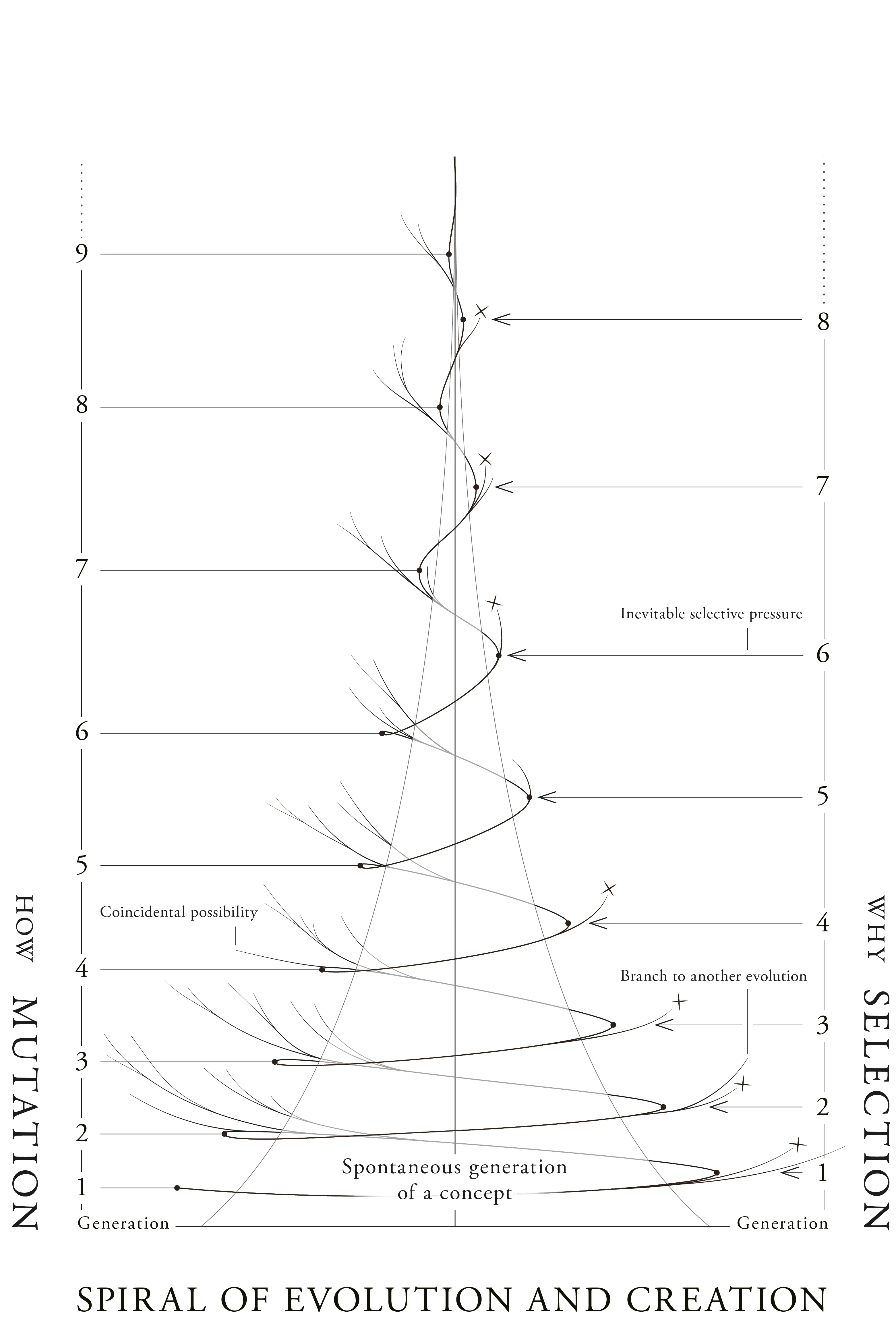
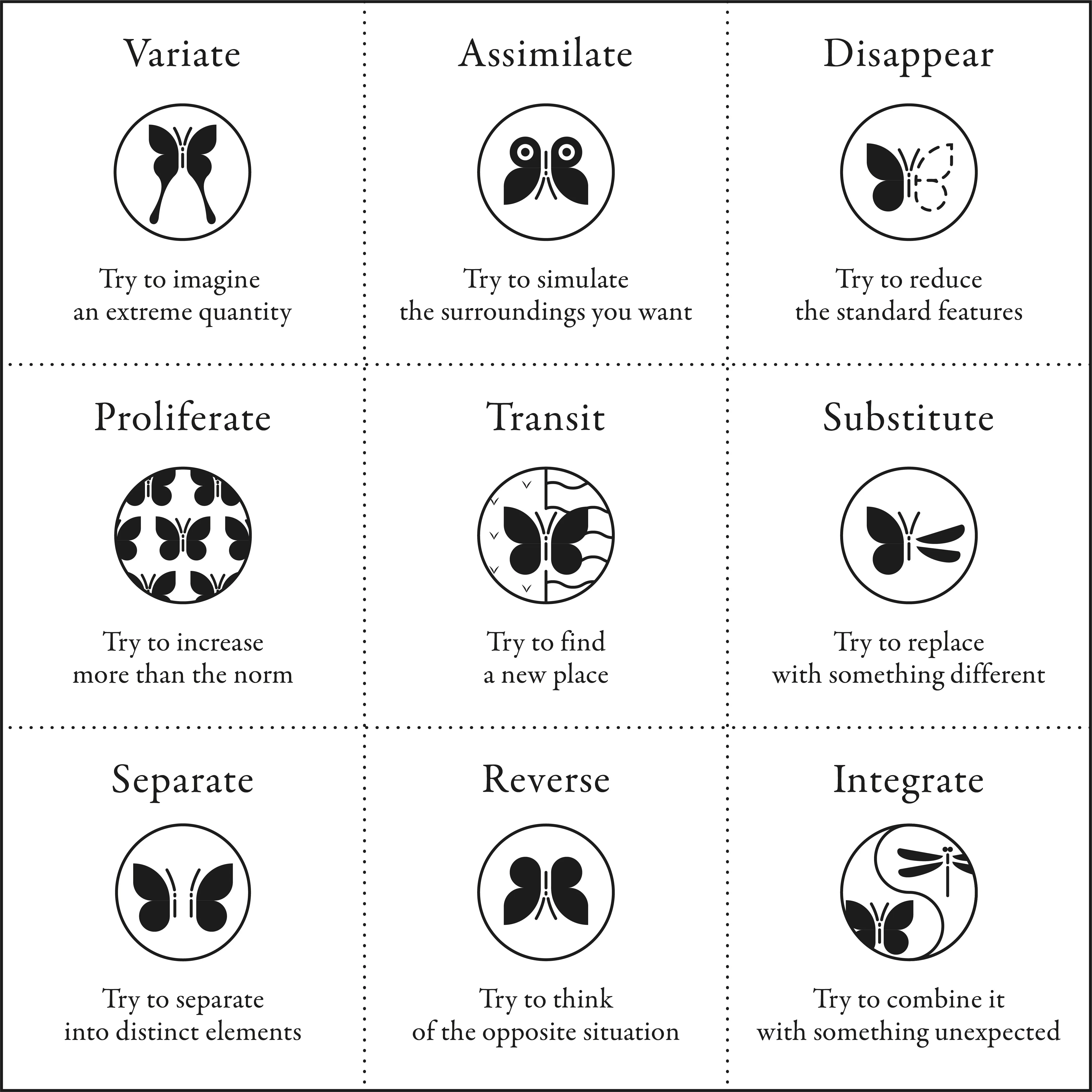
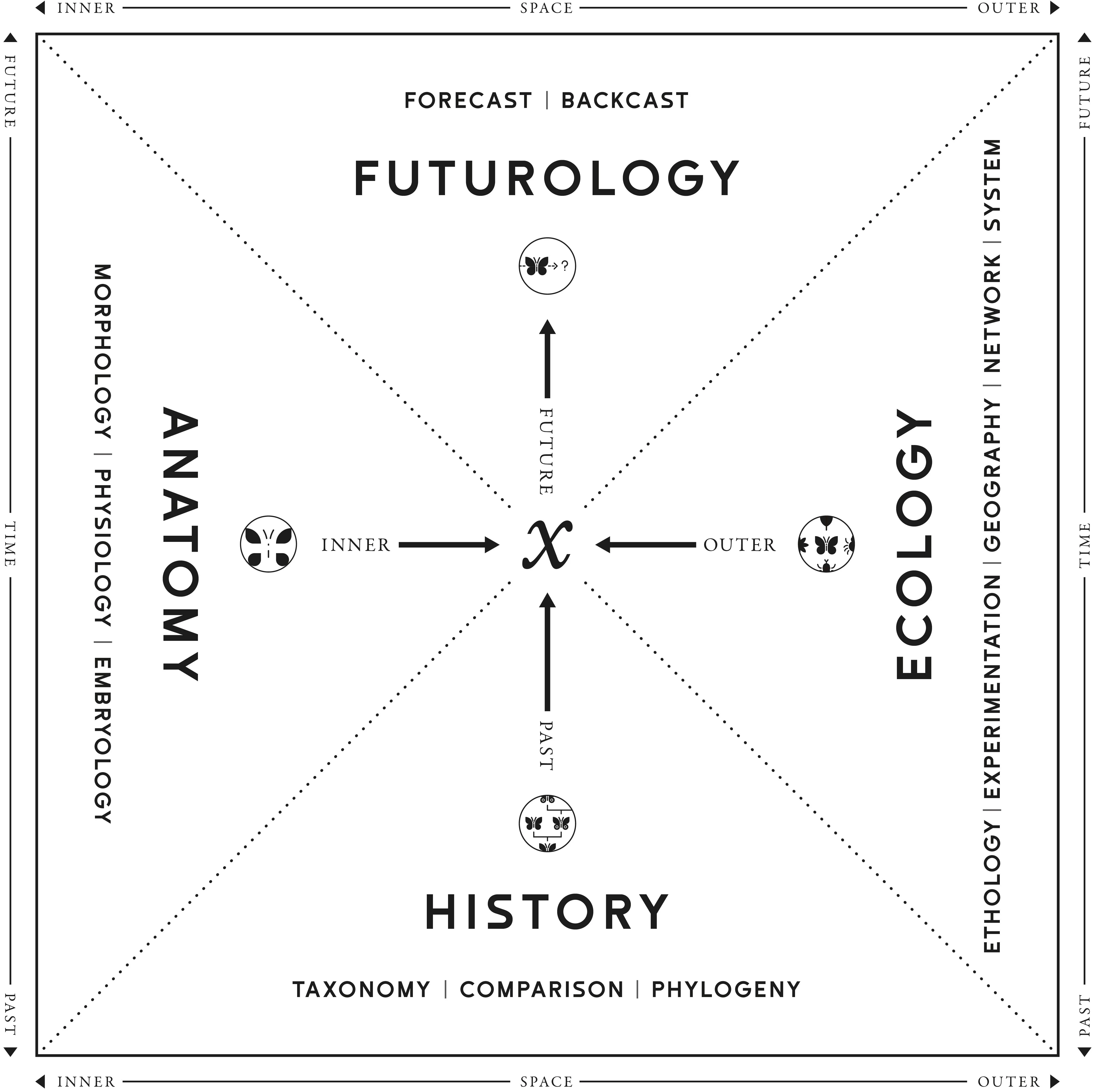
Kreativitas Evolusioner adalah cara berpikir untuk menciptakan konsep-konsep kreatif yang dapat bertahan dalam waktu lama sambil menggunakan dan bergantian antara dua ide yaitu Mutasi dan Seleksi.
(Edisi pertama buku Kreativitas Evolusioner menggunakan ungkapan "mutasi dan adaptasi" yang merujuk pada mutasi kebetulan dan seleksi alam yang bertujuan untuk adaptasi. Namun, edisi revisi telah mengubah ungkapan tersebut menjadi "mutasi dan seleksi" agar lebih sesuai dengan kebenaran akademis.)
Pada April 2021, Evolutional Creativity mulai dijual sebagai buku pertama yang diterbitkan oleh Amanokaze, penerbit pertama yang didirikan di Ama, Prefektur Shimane, di sebuah pulau terpencil dengan populasi sekitar 2.000 orang dekat perbatasan nasional. Meskipun diterbitkan di lokasi terpencil, buku ini menjadi bestseller No. 1 Amazon Jepang dalam kategori Bisnis & Ekonomi. Dalam satu minggu sejak peluncurannya, buku ini terjual 30.000 eksemplar dalam tiga kali cetak. Penjualan buku terus berkembang luas.
Buku ini juga telah memenangkan berbagai penghargaan di Jepang. Salah satunya adalah Penghargaan Yamamoto Shichihei, penghargaan akademik bergengsi yang diberikan setiap beberapa tahun untuk buku-buku humaniora yang mewakili Jepang. Komite seleksi terdiri dari dua biolog (anatomis Takeshi Yoro dan biolog evolusi Mariko Hasegawa), ekonom ilmu sosial Motoshige Ito, ilmuwan politik Terumasa Nakanishi, dan sarjana hukum Hidetsugu Yagi. Buku ini mendapat pengakuan akademis lintas humaniora dan sains.
Dengan Evolutional Creativity, kami ingin membuktikan bahwa kami dapat mengubah dunia bahkan dari lokasi terpencil. Kami juga ingin menyebarkan program pendidikan kreativitas baru ini ke dunia.
VOICE
Evolusi mengikuti berbagai hukum yang diakui. Penulis menggunakan hukum-hukum ini sebagai fondasi, bertujuan untuk menyediakan materi referensi yang berharga untuk apa yang disebut inovasi.
Meskipun detail spesifik dari setiap kasus sebaiknya dieksplorasi dengan membaca buku itu sendiri, orisinalitas ide—menerapkan prinsip-prinsip evolusi untuk memikirkan inovasi—jauh melampaui panduan praktis pada umumnya. Contoh-contoh yang disajikan di setiap bagian hidup dan menarik, membuat buku ini menyenangkan untuk dibaca. Ini mencerminkan pemikiran penulis yang berkelanjutan dan tanpa lelah.
3,5 miliar tahun evolusi biologis di Bumi telah membawa kita kepada diri kita sekarang, membentuk siapa kita hari ini. Jika proses tersebut dipandu oleh hukum-hukum tertentu, tidak ada alasan mengapa hukum-hukum yang sama tidak dapat dijadikan referensi untuk proses-proses yang akan datang.
Pendekatan penulis pada dasarnya analogis. Konrad Lorenz, sang etolog, pernah berkomentar dalam pidato Nobel-nya bahwa metodenya murni analogis. Di dunia akademis, yang sering menekankan "orisinalitas," sedikit yang akan mengakui hal ini. Namun dalam konteks di mana orisinalitas dihargai—seperti dalam inovasi—signifikansi analogi menjadi jelas. Dalam hal ini, karya ini sangat berharga dan layak mendapat Penghargaan Yamamoto Shichihei.
Yoro Research Institute, Ltd. /
Professor Emeritus, Universitas Tokyo
Takeshi Yoro

Tentang Desain Buku
Buku ini dirancang oleh Tachikawa, sang penulis sendiri.
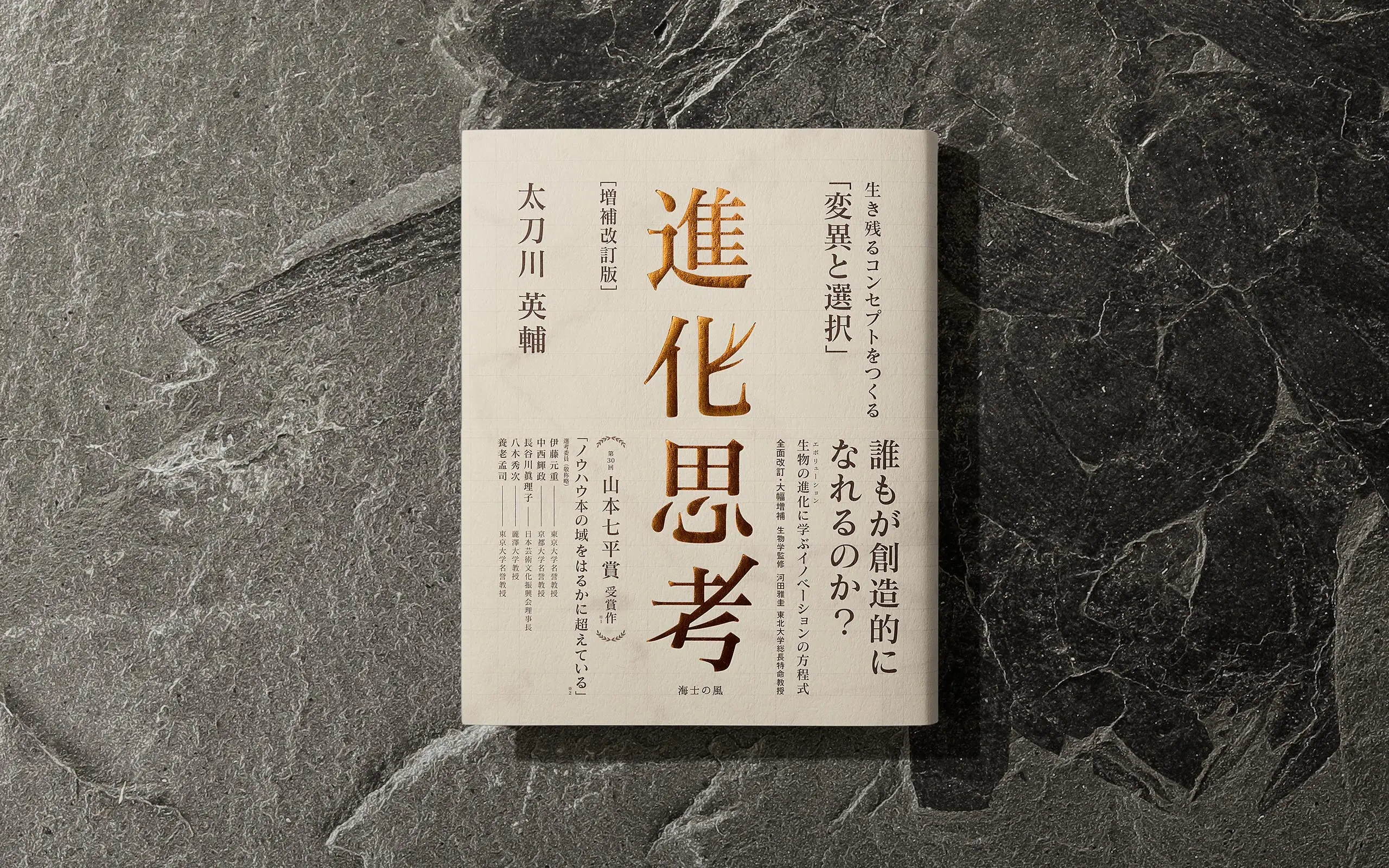
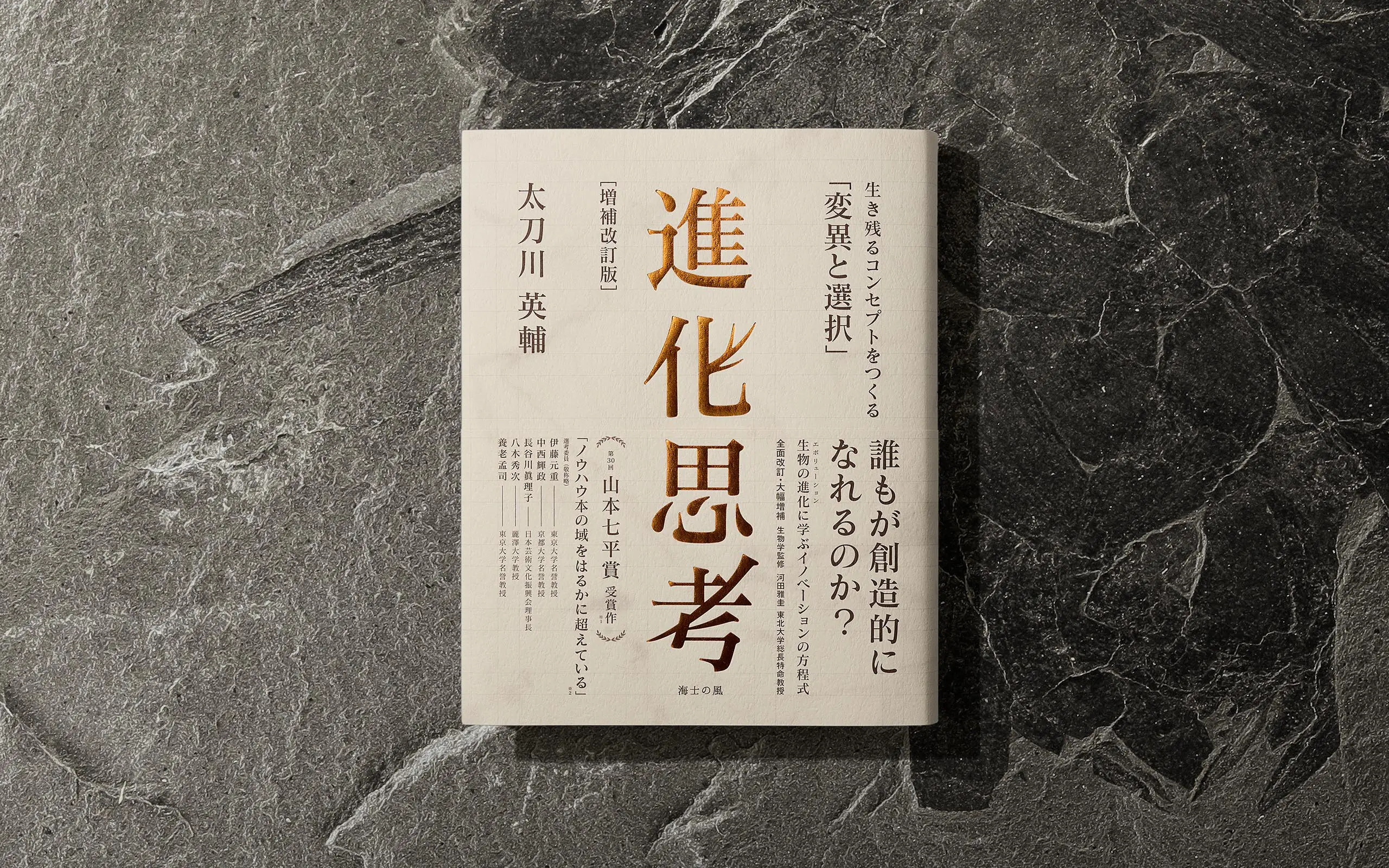
Dia ingin buku tersebut terus dicintai melampaui masa kini. Terinspirasi oleh lapisan geologis yang terbentuk selama berabad-abad, dia memutuskan desain dan tekstur seperti batu. Ini juga merupakan penghormatan kepada penelitian geologis James Hutton yang mempengaruhi Teori Evolusi Charles Darwin.
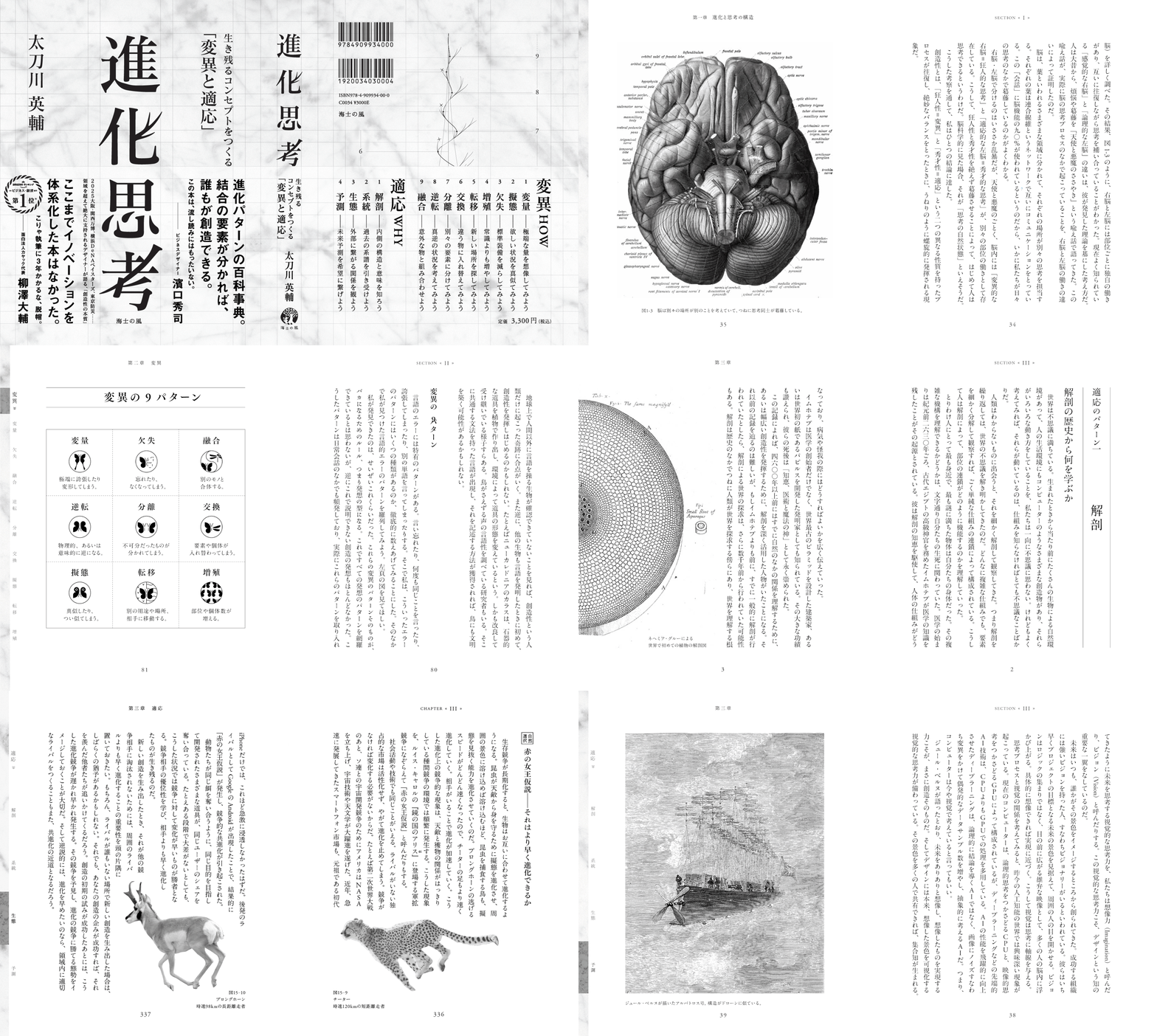
Sampul buku menggunakan kertas berpola emboss (bernama "Iwa-hada" atau permukaan batu) dengan tekstur seperti batu, di mana pola marmer dicetak. Karena tepi buku juga memiliki pola marmer yang sama, buku setebal 500+ halaman tersebut tampak seperti bata batu yang tebal dan kokoh. Juga, dengan menghilangkan elemen dekoratif sebanyak mungkin dan memiliki desain minimalis, nada warna yang seragam dipertahankan. Ini adalah desain buku yang abadi dan menarik yang tidak terpengaruh oleh tren desain apa pun.
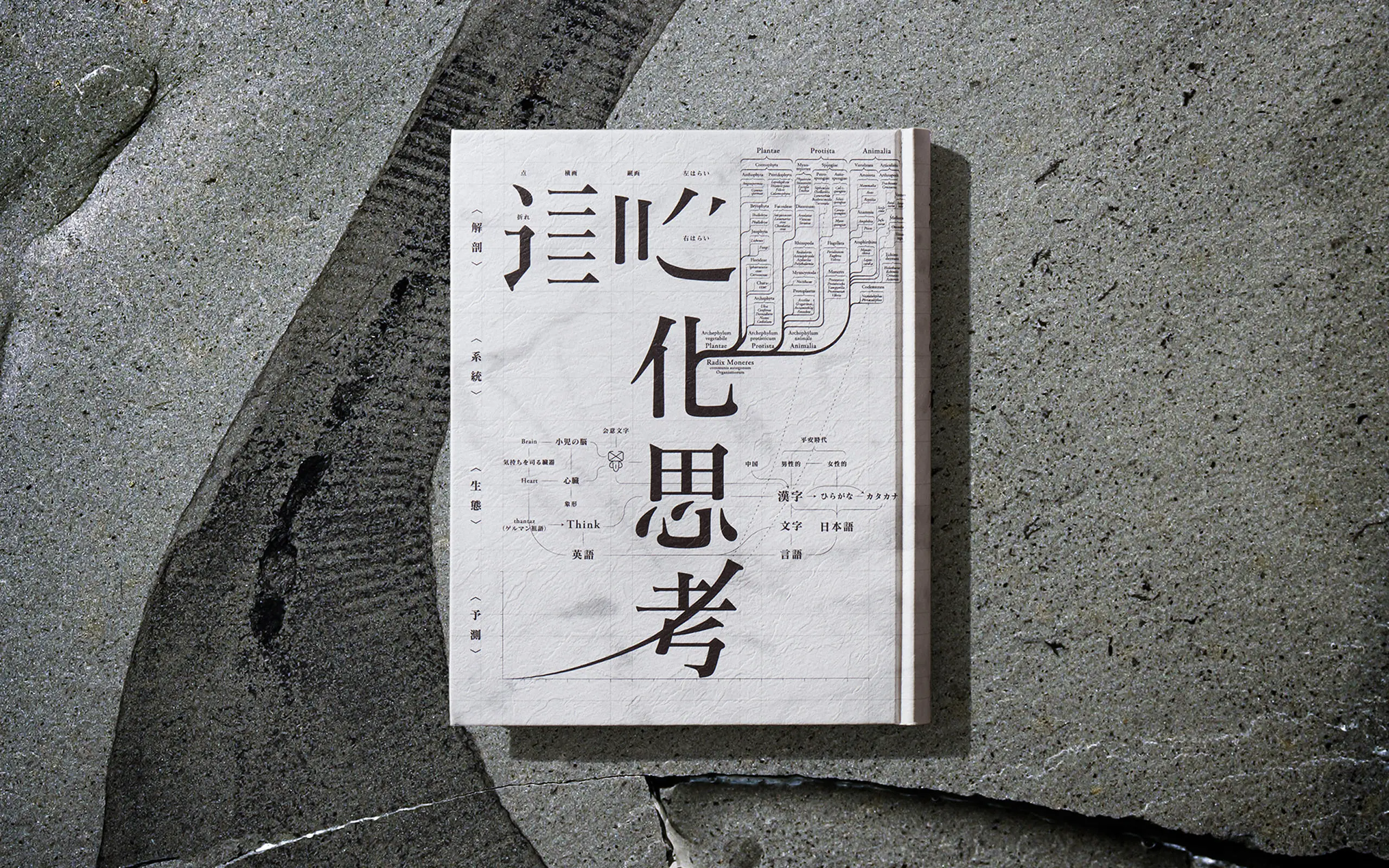
Logo judul buku menunjukkan empat karakter kanji (進 化 思 考) dalam transisi berdasarkan pola mutasi Kreativitas Evolusional yaitu Proliferate, Assimilate, Reverse, dan Variate. Ketika sampul kertas dilepas, sampul buku menunjukkan empat karakter kanji yang sama sebagai representasi visual dari empat ide pembelajaran spasial-temporal: Anatomy, Lineage, Ecosystem, dan Prediction.
Logo yang dicetak mungkin terlihat hitam ketika dilihat langsung dari atas, tetapi tampak coklat ketika dilihat dari sudut tertentu. Efek ini diciptakan melalui foil hot stamping "coffee brown" dari Murata Kimpaku Company dan dirancang untuk terlihat seperti permata yang berkilau samar yang tertanam dalam marmer.

Karena Tachikawa adalah desainer buku sekaligus penulis, ia dapat secara efektif merancang tata letak konten utama dengan menggunakan teks yang mengelilingi ilustrasi untuk mengintegrasikan ilustrasi ke dalam teks. Indeks buku juga memiliki pola marmer untuk memudahkan pencarian topik dan pembacaan ulang teks.
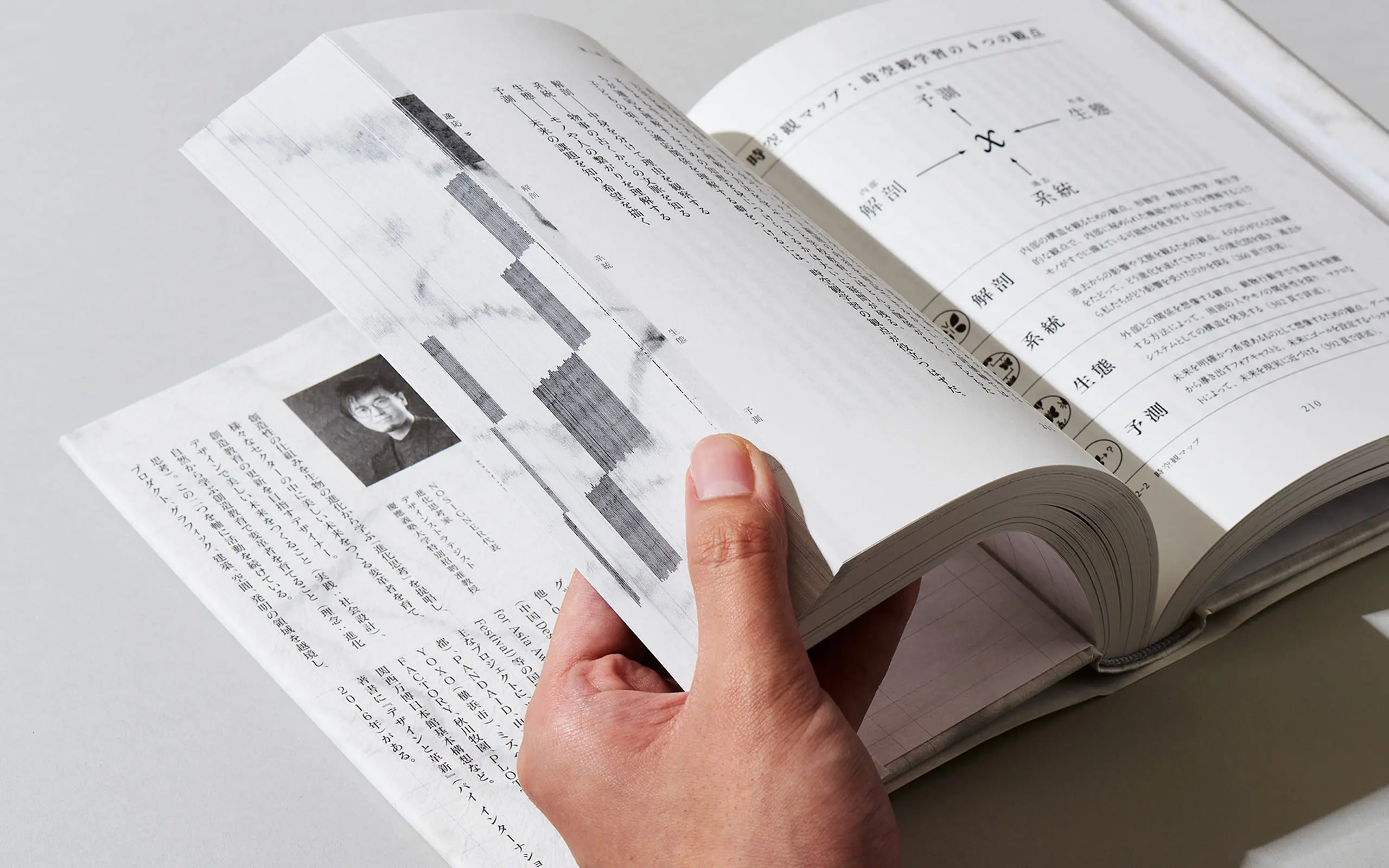
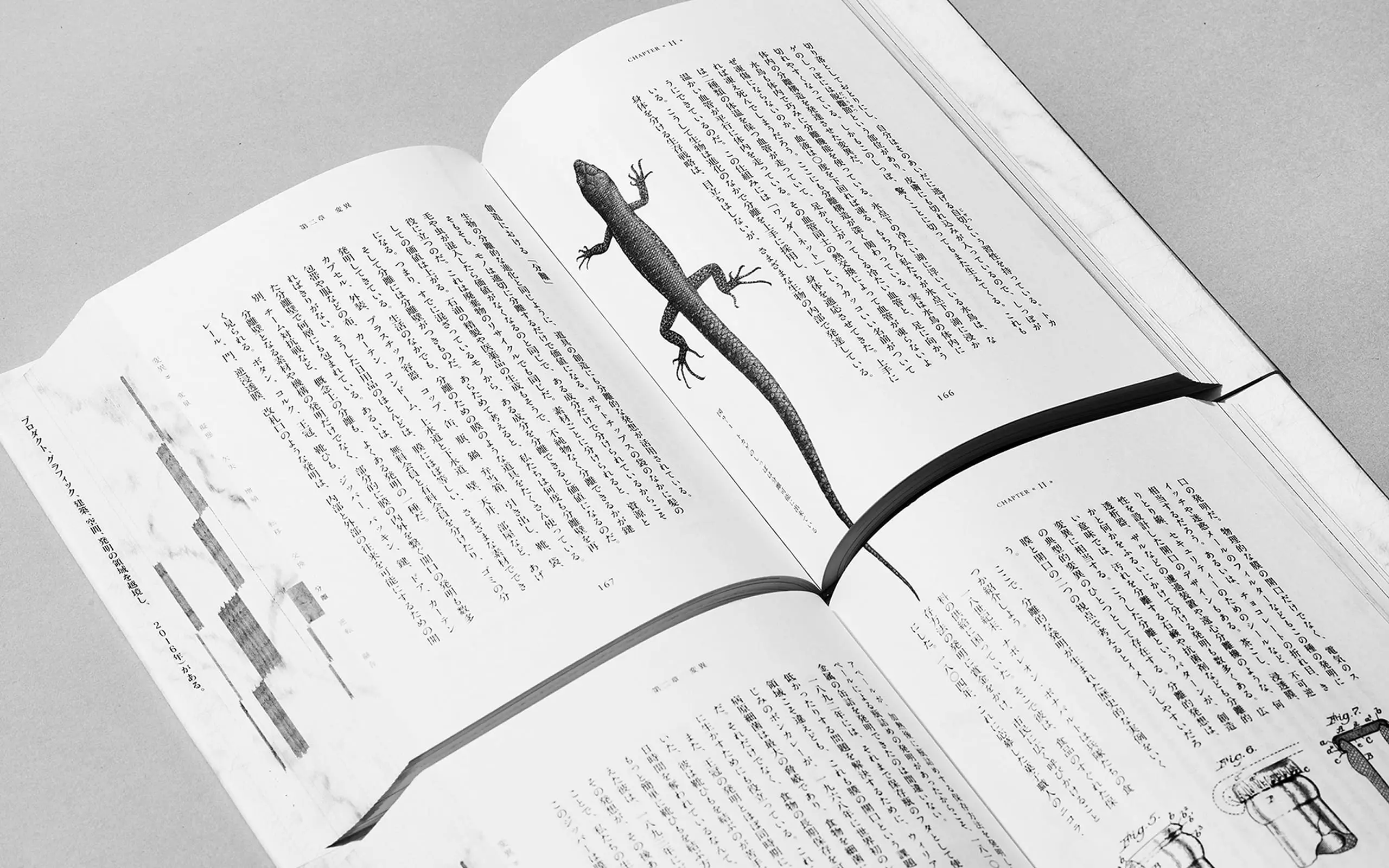
Memanfaatkan fakta bahwa buku ini berasal dari workshop kreativitas di perusahaan dan universitas, buku ini mencakup 50 workshop yang mendorong pemikiran kreatif. Alih-alih hanya menjadi buku teks untuk dibaca, Anda juga dapat mencoba dan mempraktikkan ide-ide kreatif Anda. Meskipun buku ini memiliki panjang lebih dari 500 halaman, buku ini mudah dibaca dan mudah digunakan. Buku ini dapat digunakan sebagai referensi yang sering atau ensiklopedia untuk mencari topik "kreativitas" dan "evolusi biologis".
WHY
Apakah kreativitas adalah sesuatu yang terbatas pada mereka yang memiliki bakat?
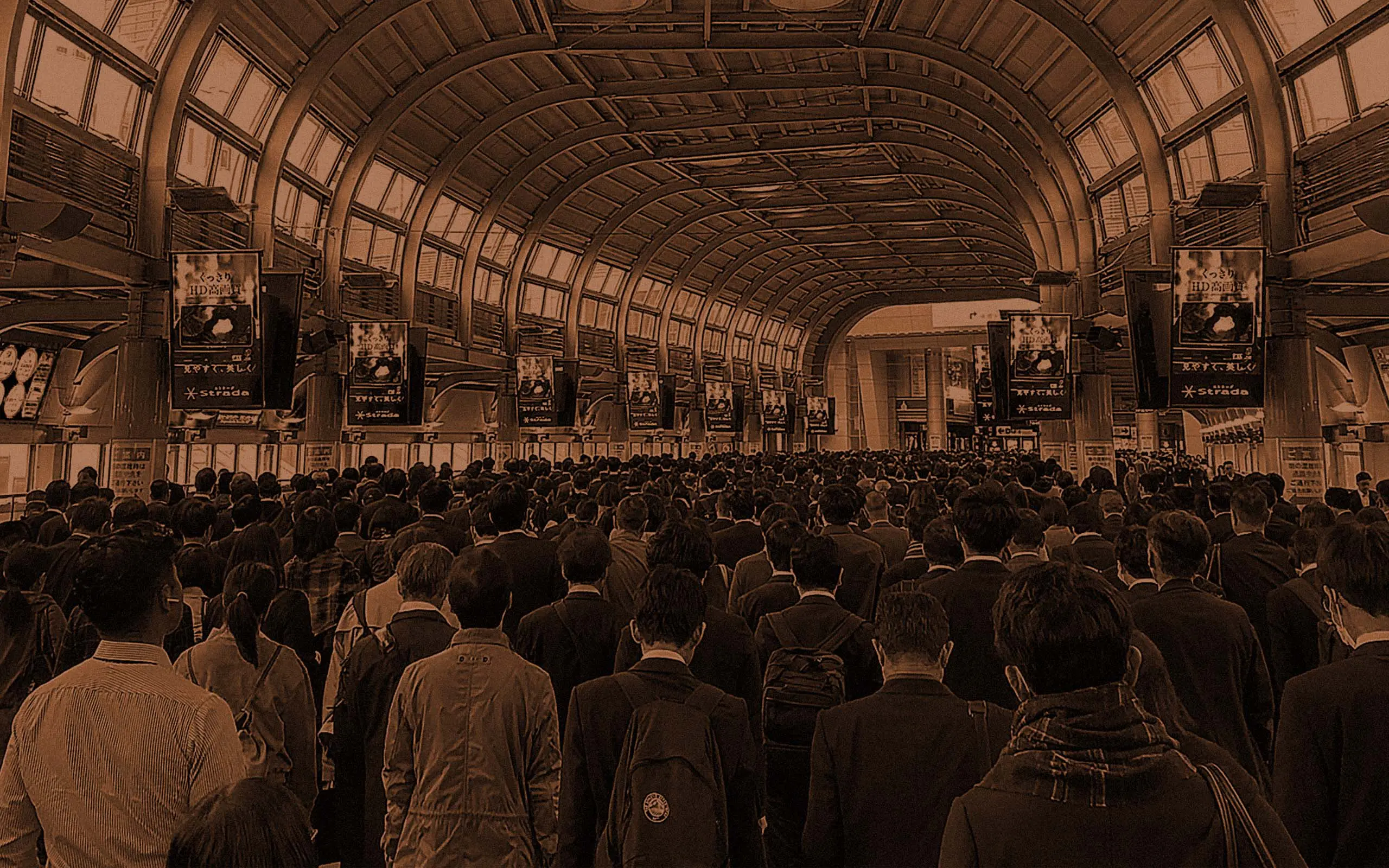
Dalam mengejar keinginan kita, manusia telah menjadi kreatif dan menciptakan berbagai macam alat, sehingga berkontribusi pada perkembangan peradaban kita. Meskipun penting, kreativitas umumnya dianggap sebagai kemampuan bawaan yang memerlukan bakat alami untuk memunculkannya. Apakah kreativitas adalah sesuatu yang tidak bisa dipelajari?
"Kecerdasan Terkristalisasi dan Cair" oleh Raymond Cattell

Status target SDG individual pada titik tengah Agenda 2030

Grafik siswa Jepang yang menganggap mereka kreatif

Ada banyak orang yang mengira mereka tidak memiliki bakat kreatif karena mereka tidak pandai melukis di kelas seni, dll. Satu survei yang mengecewakan menemukan bahwa hanya delapan persen mahasiswa di Jepang yang menganggap diri mereka kreatif.
Apakah kita benar-benar memahami kreativitas secara menyeluruh? Ketika kita memikirkannya, kita mungkin menyadari betapa sedikit yang kita ketahui tentang bagaimana kreativitas bekerja dan bagaimana kita dapat dilatih untuk itu. Jika kita dapat memahami cara kerja kreativitas, kita mungkin dapat memperolehnya.
Dalam beberapa tahun terakhir, sekolah-sekolah mulai memikirkan partisipasi aktif siswa seperti pembelajaran aktif dan pembelajaran berbasis inkuiri. Ini untuk memupuk kreativitas dan pikiran ingin tahu yang tidak terikat oleh kerangka konvensional mata pelajaran kelas. Bahkan di dunia bisnis, metode berpikir yang merangsang kreativitas mendapat lebih banyak perhatian.
Jika kita memiliki lebih banyak orang yang memulai proyek kreatif, itu akan mengarah pada masyarakat yang lebih berkelanjutan dan solusi dasar untuk berbagai masalah sosial. Untuk tujuan ini, kita perlu memahami kreativitas itu sendiri dan menetapkan teori dan program pendidikan untuk belajar tentang kreativitas secara sistematis.
WILL
Memperbarui pengajaran kreatif dan mengatasi dunia yang tidak berkelanjutan.
Kreativitas Evolusional telah memperoleh penerimaan dan pengakuan yang luas sebagai metode inovasi paling kuat di dunia, setelah diadopsi oleh perusahaan-perusahaan besar Jepang dan institusi pendidikan seperti Panasonic, Fujitsu, Sumitomo House, dan Keio University. Metode ini bahkan telah dimasukkan sebagai pertanyaan dalam ujian masuk untuk bahasa nasional di Doshisha University. Seiring semakin banyak individu yang mengadopsi pemikiran kreatif ini dan menghasilkan proyek-proyek transformatif untuk keberlanjutan, jangkauan Kreativitas Evolusional terus berkembang. Bahkan para ahli AI terkemuka di Jepang menggabungkan prinsip-prinsip Kreativitas Evolusional ke dalam pekerjaan mereka, dan workshop yang memanfaatkan metode ini telah diadakan di pameran lingkungan hewan terbesar di negara tersebut di kebun binatang. Kreativitas Evolusional secara bertahap memasuki berbagai bidang yang luas, dan dampaknya akan terus berkembang.
Meskipun ada kesuksesan awal dan pengakuan terhadap Kreativitas Evolusional, implementasi proyek-proyek pendidikan yang benar-benar kreatif yang mengambil inspirasi dari hukum-hukum alam masih dalam tahap awal.
Saat umat manusia terus maju melalui teknologi, kita juga menghadapi konsekuensi dari perubahan drastis terhadap geologi dan iklim, serta keruntuhan ekosistem. Kita telah memasuki "Antroposen," era geologi di mana aktivitas manusia memiliki efek yang mendalam terhadap bumi. Dengan peradaban kita telah melampaui "batas planet," titik di mana perubahan lingkungan yang tidak dapat diubah dan mendadak menjadi kemungkinan nyata, waktu sangatlah penting. Sangat krusial bahwa kita menerapkan metode pendidikan yang inovatif dan efektif seperti Kreativitas Evolusional untuk memastikan kelangsungan hidup kita dan membuka jalan untuk masa depan yang berkelanjutan.


Ekspresi kreativitas manusia yang sempit telah menyebabkan krisis keruntuhan peradaban, namun kreativitas kita tetap menjadi satu-satunya cara bertahan hidup di bumi. Sangat penting bagi kita untuk memahami esensi kreativitas dan menggunakannya secara maksimal dalam mengatasi berbagai masalah dan menciptakan masyarakat yang berkelanjutan. Sekarang saatnya bagi kita untuk menggali lebih dalam pemahaman tentang kreativitas dan menerapkannya pada solusi yang mendorong koeksistensi antara manusia dan lingkungan.
Friedrich Fröbel, seorang pelopor dalam pendidikan anak usia dini yang berkembang pada abad ke-19, meletakkan dasar untuk pendidikan kreativitas dengan mengambil inspirasi dari ilmu pengetahuan alam dan telah memberikan pengaruh signifikan pada gerakan-gerakan selanjutnya seperti Bauhaus. Namun, meskipun ada karya revolusioner dari Fröbel dan Bauhaus, pendidikan kreativitas sebagian besar tetap tidak berubah selama satu abad terakhir. Tujuan kami adalah mengembangkan dan merevitalisasi bidang pendidikan ini, untuk mengikuti kebutuhan masyarakat dan lingkungan yang terus berubah.
Kami percaya bahwa dengan memperbarui pendidikan kreativitas melalui lensa Evolutional Creativity, kami dapat memberdayakan individu untuk secara kreatif mengatasi isu-isu sosial mendesak di zaman kita dan memaksimalkan kreativitas setiap orang di setiap komunitas. Dengan membekali individu dengan alat untuk berpikir dan bertindak dengan cara-cara baru dan inovatif, kami dapat bekerja menuju penyelesaian tantangan besar yang dihadapi manusia dan membangun masa depan yang lebih baik untuk semua.
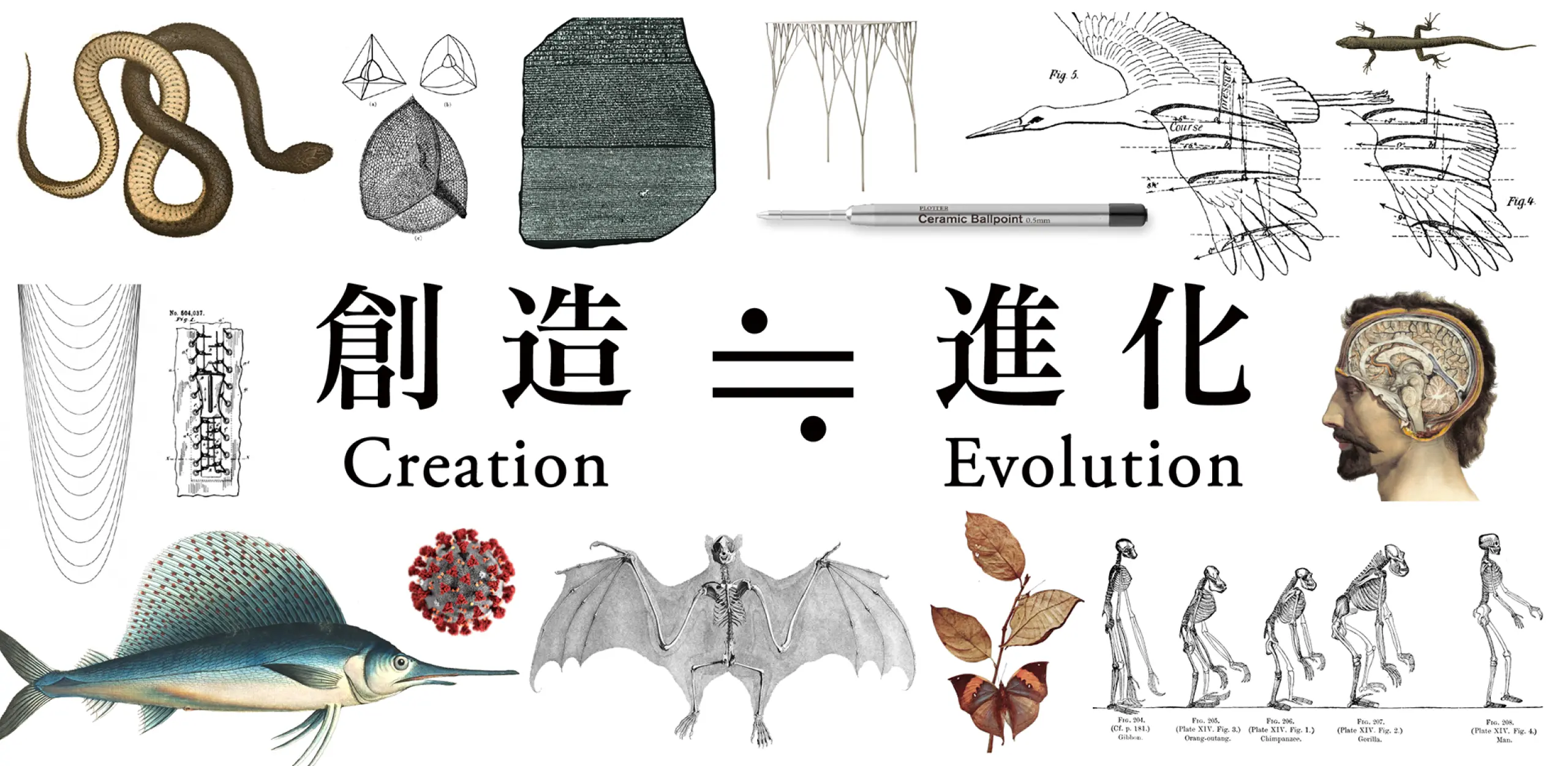

Buku " Evolutional Creativity " menduduki peringkat No. 1 di ranking buku bisnis dan ekonomi Amazon segera setelah mulai dijual untuk pre-order, dan dengan cepat dicetak ulang sebelum perilisannya. Apakah cara berpikir baru ini yang membangkitkan kreativitas yang tertidur dalam diri setiap orang?
Situs Terkait /
The Evolution of “Evolutional Creativity” (Updated November 2025)
November 2025: Keynote Speech at the 9th Leadership Summit 2025 in Bangladesh
Eisuke Tachikawa took the stage as a keynote speaker at the “Leadership Summit 2025” held in Bangladesh. Held under the theme “Resilient Leadership – Thriving Amid Uncertainty,” this international conference explored the sustainable and ethical leadership required in a rapidly changing society. Tachikawa delivered a speech on the nature of leadership in addressing social issues and environmental changes from the perspective of Evolutional Creativity.
November 2025: Online Presentation at the 12th Anniversary Commemoration of Typhoon Yolanda
Marking the 12th anniversary of Typhoon Yolanda—which caused some of the worst damage ever recorded in the Philippines—Eisuke Tachikawa spoke at a commemorative event held at Eastern Visayas State University. He delivered an online lecture on “Evolutional Creativity” to approximately 400 participants, sharing creative perspectives on how to confront disasters.
November 2025: Delivered a Special Lecture to Graduate Students at Minerva University
At Minerva University—known for its unique educational model that involves learning while moving between seven cities worldwide and having been selected as “the world’s most innovative university”—Eisuke Tachikawa delivered a special lecture on “Evolutional Creativity” to approximately 20 graduate students majoring in “Decision Science.” Students from diverse backgrounds, including current politicians and corporate leaders, visited the Yokohama studio of NOSIGNER—the firm led by Tachikawa—and the lecture lasted three hours due to a lively Q&A session.
October 2025: Presentation at the “Cities of Design Subnetwork Meeting” Conference Hosted by the UNESCO Creative Cities Network (UCCN)
Eisuke Tachikawa spoke at the “Cities of Design Subnetwork Meeting” hosted by the UNESCO Creative Cities Network (UCCN)—which aims to harness culture and creativity for sustainable urban development—at the Bandung Institute of Technology. He participated in a panel discussion themed “Creative City 2.0,” exchanging views on approaches to creativity based on “Evolutional Creativity” and the future of cities adapting to climate change.
September 2025: Keynote Speech at the International Design Conference (IDC) 2025 in the Philippines
Eisuke Tachikawa delivered a keynote speech at the International Design Conference (IDC) 2025, organized by the Design Center of the Philippines, the government agency responsible for promoting design in the Philippines. Invited as a keynote speaker to the conference, which featured a diverse lineup of speakers including consultants, designers, researchers, and business executives under the theme “Holding the Whole,” he delivered a keynote address on creativity education based on “Evolutional Creativity” and the ideal form of cities adapting to climate change.
July 2025: Received the Highest Academic Award from Bandung Institute of Technology
He was awarded the “GANESA WIDYA JASA ADIUTAMA Award,” the highest academic honor bestowed by the Bandung Institute of Technology (ITB) in Indonesia for outstanding contributions to knowledge and education. This prestigious award is granted to only two individuals following a rigorous selection process from candidates nominated by each faculty; he was selected based on a nomination from the Faculty of Art and Design (FSRD).
November 2024: Publication of the Indonesian Edition of *Evolutional Creativity*
The Indonesian edition of the book *Evolutional Creativity* was published by the Indonesian publishing house “SiMPUL” under the supervision of the Bandung Institute of Technology (ITB), one of Indonesia’s leading universities.
Additionally, to commemorate the book’s publication, an exhibition and commemorative lecture were held at the ITB Design Center, and an exhibition and workshop were also held at the Jakarta art space “
April 2024: 3rd Anniversary of the Publication of “Evolutional Creativity”
“Evolutional Creativity,” systematized by its proponent, Eisuke Tachikawa, after years of exploration, has continued to evolve even today, having received a wide range of feedback—including support, encouragement, criticism, and suggestions—from many people since the first edition of the book was published.
Furthermore, a reader community formed by over 100 enthusiastic readers remains actively engaged, and the principles of Evolutional Creativity are being put to practical use in the work and daily lives of its practitioners.
March 2024: Lecture at the Ministry of Economy, Trade and Industry for Stanford Business School Students
Tachikawa delivered a lecture on Japanese design and Evolutional Creativity to approximately 30 students and faculty members from Stanford Graduate School of Business at the Ministry of Economy, Trade and Industry. This lecture was part of the school’s study tour to Japan, a program designed to explore the relationship between Japan’s rapid economic growth and design, as well as the current state of startups.
December 2023: Publication of *Evolutional Creativity [Expanded and Revised Edition]*
With biological supervision provided by evolutionary biologist Masaki Kawata (Professor by Special Appointment to the President at Tohoku University),
October 2023: Paper Presentation at the World Design Assembly International Conference
At the
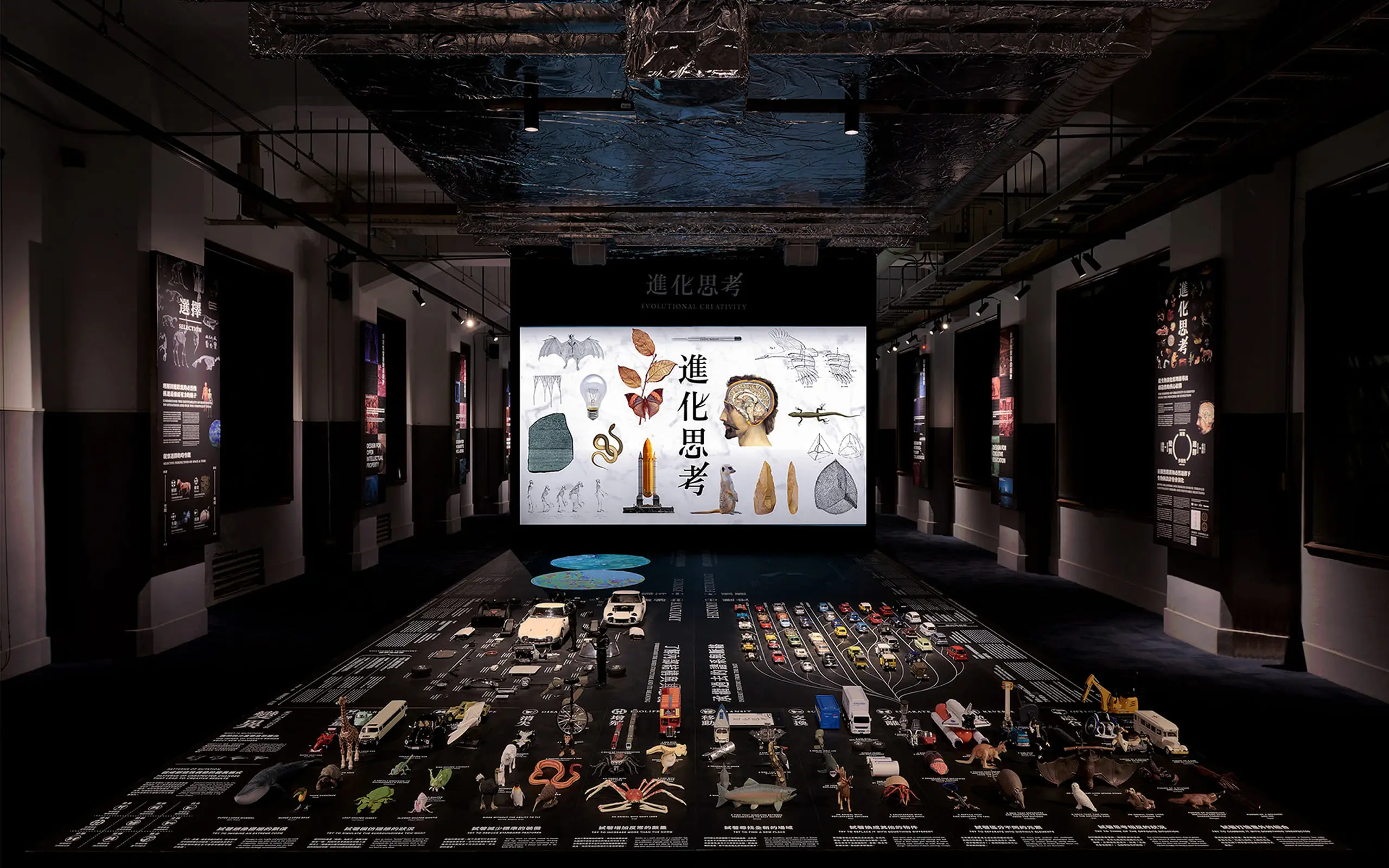
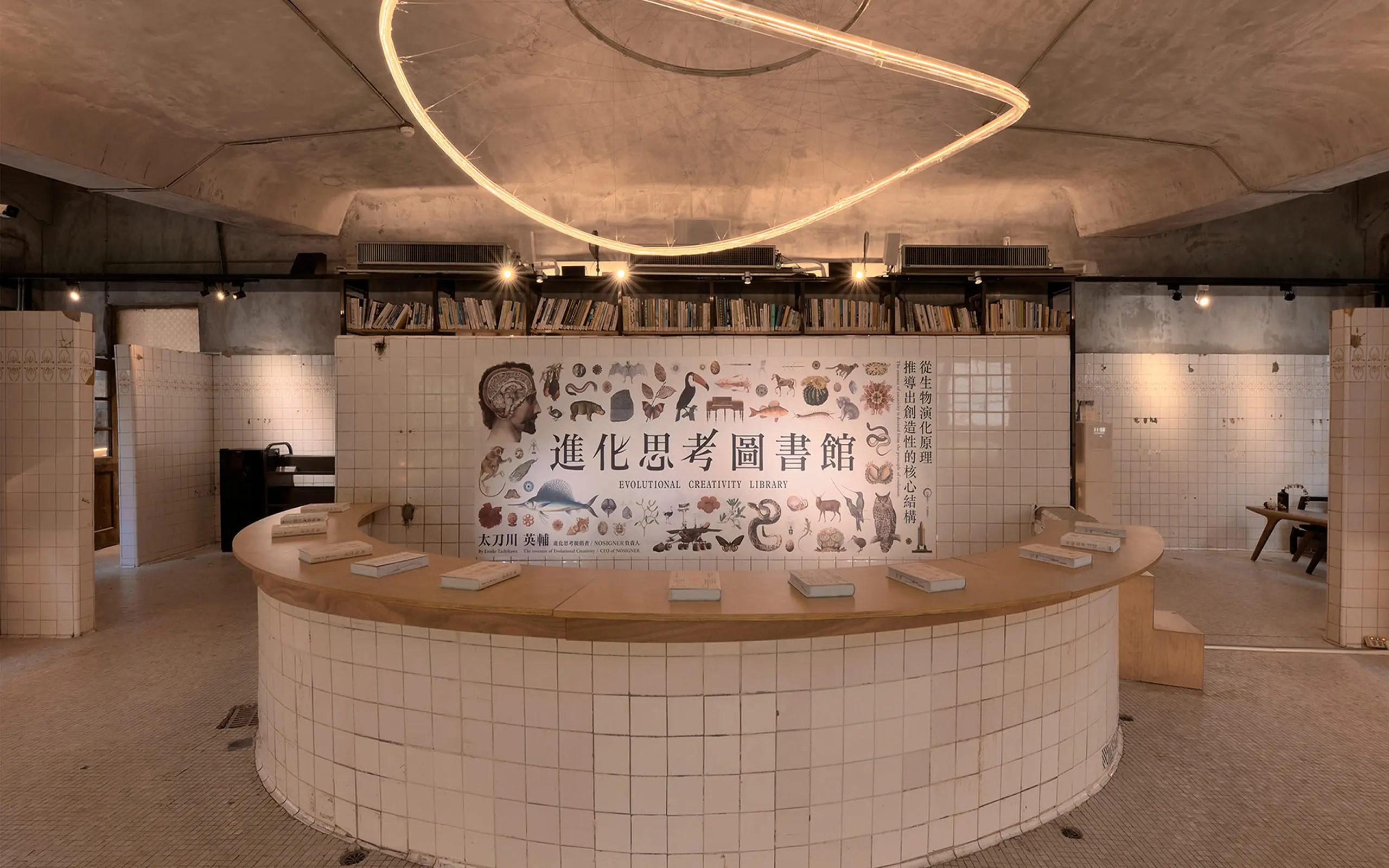
September 2023: Exhibition Held at the Taiwan Design Museum
Coinciding with the publication of the Taiwanese edition of the book *Evolutional Creativity*, an exhibition by NOSIGNER titled
September 2023: Publication of the Taiwanese Edition of “Evolutional Creativity”
Following the Korean edition, the
June 2023: Publication of the Korean Edition of “Evolutional Creativity”
The
May 2023: Presentation at a Conference Hosted by UNESCO-MGIEP
Tachikawa was invited to speak at the conference “Education for Flourishing in a Mixed Reality,” organized by UNESCO-MGIEP (the United Nations Educational, Scientific and Cultural Organization’s Mahatma Gandhi Institute of Education for Peace and Sustainable Development), which brought together renowned scholars, researchers, teachers, policymakers, and representatives from the private sector from around the world. He delivered a presentation on “Evolutional Creativity” during the “Design Thinking and Creativity in Education” session. This conference was also the first international conference based on the Sustainable Flourishing Goals.
March 2023, August 2023: Lecture at the Bandung Institute of Technology (ITB), Indonesia
Tachikawa delivered a lecture on Evolutional Creativity at the Bandung Institute of Technology (ITB), Indonesia’s premier institution of higher learning. Due to the positive reception of this content, it was decided to publish an Indonesian-language edition of “Evolutional Creativity.” Following the
March 2023: Chaired the “Thinking About the Future of Higher Education” Forum
Eisuke Tachikawa served as chair of the “Thinking About the Future of Higher Education” forum, organized by the Benesse Educational Research Institute, where members engaged in cutting-edge educational practices discussed the future of university education. After four rounds of roundtable discussions with committee members, a proposal outlining a vision for university education that envisions a hopeful future was compiled. Under the new educational guiding principle, “
November 2022: Received the “Shu Yamaguchi Award” at the Pen Creator Awards
Eisuke Tachikawa received the “Shu Yamaguchi Award” at the “
November 2022: Appeared in an NHK program for a dialogue with anatomist Takeshi Yoro
He appeared alongside anatomist Takeshi Yoro on the popular NHK program “Switch Interview,” in which two people working in different fields visit each other’s workplaces and conduct a dialogue while “switching” between the roles of speaker and listener. In the second part of the program, I invited Dr. Yoro—who has spent nearly 60 years since his student days exploring “the forms of living things”—to the NOSIGNER studio. While introducing the concept of “Evolutional Creativity,” I spoke about my work as a designer who has pursued form through various approaches.
June 2022: Project to Launch Revised Edition of
A project to publish a revised edition has begun, aiming to further refine the book as a method of creative thinking and accurately incorporate scientific insights. For this revision, we invited Professor Masaki Kawata, a professor on special assignment to the President at Tohoku University and an expert in evolution and ecology, to serve as supervising editor, accompanying the evolution of the “Evolutional Creativity” book. A new book by Professor Kawata explaining evolutionary biology was recently published, so please take a look at that as well.
For the author as well, this was an invaluable opportunity to deeply re-learn evolutionary biology from such a distinguished expert as Professor Kawata.
May 2022: Dialogue with Nobel Laureate Dr. Akira Yoshino
At an event commemorating Asahi Kasei’s 100th anniversary, I had the honor of engaging in a dialogue with Dr. Akira Yoshino (Asahi Kasei Honorary Fellow), the inventor of the lithium-ion battery and Nobel Laureate in Chemistry. The video of Tachikawa’s lecture on “Evolutional Creativity” and his dialogue with Dr. Yoshino was streamed to approximately 40,000 Asahi Kasei Group employees. This event not only fulfilled Tachikawa’s long-held wish to engage in a dialogue with Dr. Yoshino but also served as an opportunity to convey the message to everyone at Asahi Kasei that “it is the ‘curiosity’ and ‘knowledge’ of each individual that enriches imagination and shapes the next 100 years.”
March 2022: Appeared on NHK E-Tele’s “Night of Radical Modifications: Engineer Training School”
Eisuke Tachikawa appeared as a “Design (Creation) Instructor” on NHK E-Tele’s popular program “Night of Radical Modifications: Engineer Training School.” With the theme of “Magic Modification of a Blender,” he led a brainstorming workshop to create a “blender that shoots juice far away,” introducing the nine “mutation” patterns from “Evolutional Creativity” as hints for generating ideas.
February 2022: Received a Special Award at the “IT Engineer Book Awards 2022”
In the business book category of the
2022–2023: Adopted in School Entrance Exam Questions
Excerpts from *Evolutional Creativity* were adopted as material for entrance exams at several schools, including as a topic for the Japanese language entrance exam at Doshisha University.
November 2021: Winner of the Yamamoto Shichihei Prize
We received the
While “Evolutional Creativity” has garnered attention as a method for fostering innovators and driving innovation, winning this prestigious Japanese academic award—whose selection committee includes anatomist Takeshi Yoro, evolutionary biologist Mariko Hasegawa, economist Motoshige Ito, political scientist Terumasa Nakanishi, and legal scholar Shuji Yagi—has allowed it to gain recognition from an academic perspective as a new way of thinking that unravels creativity from an evolutionary viewpoint.
April 2021: Publication of the book *Evolutional Creativity*
We published this book with the aim of conveying the concepts and methodology of Evolutional Creativity to a wide audience, including the business sector, and encouraging its application to idea generation across all fields, such as business development, design, and art.
Packed with a wealth of photographs and illustrations on biological evolution and human creativity, as well as 50 “Evolutional Creativity Works” that readers can practice while reading, this book—which comprehensively covers the concepts and practical methods of Evolutional Creativity—became a bestseller. The Evolutional Creativity methodology has spread to major corporations and educational institutions and has even been adopted in entrance exams for universities and high schools.
“Evolutional Creativity” is a concept that Tachikawa had been nurturing for many years prior to the book’s publication in 2021. Below is a summary of the journey leading up to the publication of *Evolutional Creativity*.
2021: Collaboration with NHK’s TV Program “The Direxon”
We collaborated on a project for NHK’s TV program
August 2020: “School of Evolution” Launches
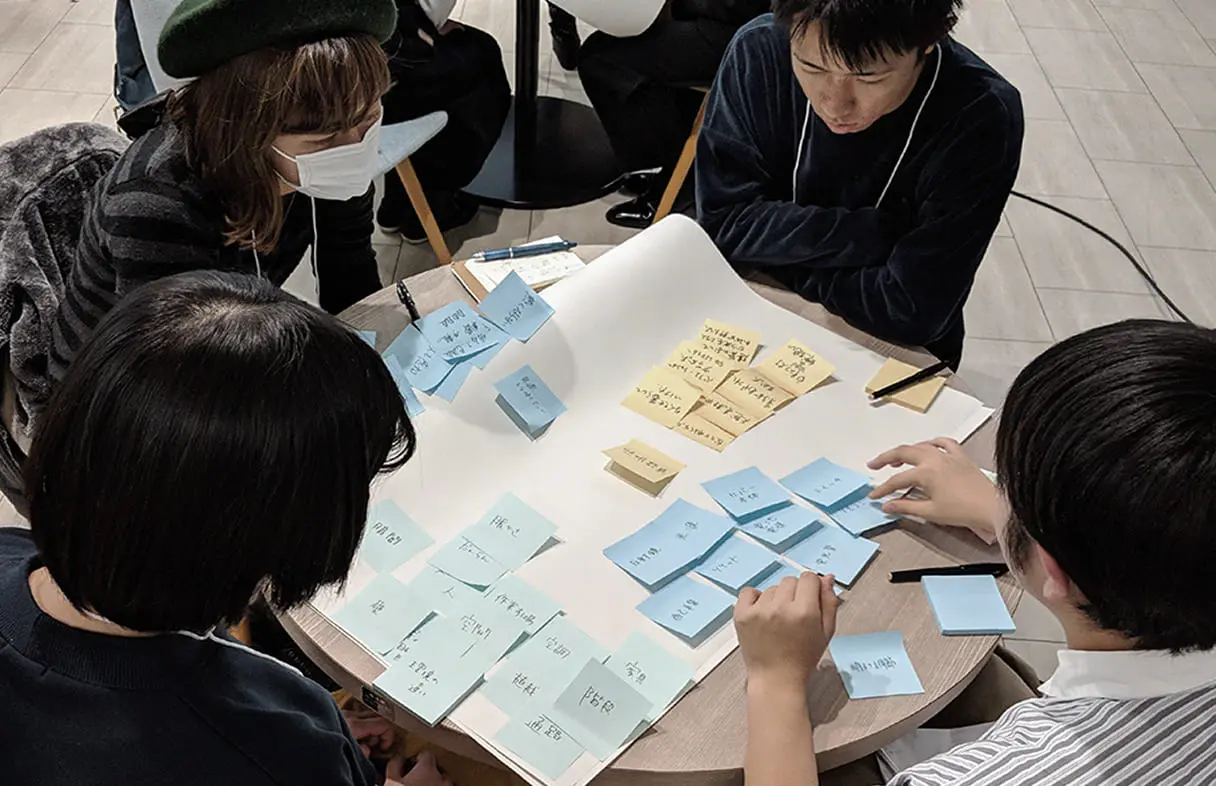
An online course was launched through the voluntary efforts of Takashi Yamada and other members who had studied Evolutional Creativity. The “School of Evolution” began as a course designed to plant the seeds of creativity across various sectors of society. This school is a training program that helps participants refine new ideas for business creation through lectures and workshops on Evolutional Creativity.
The “School of Evolution” has attracted a diverse group of participants, including corporate executives, employees aiming to drive innovation, and school teachers and public servants seeking to engage in creative practice. To date, the program has produced approximately 1,000 graduates.
The program is offered to a wide range of participants, from corporations and organizations to individuals, and is utilized for product development and human resource development. Many graduates continue to meet weekly to explore creativity education through Evolutional Creativity.
2019: Began writing the book *Evolutional Creativity*
After meeting Mr. Abe and Mr. Harada at “Kokuri! Camp,” they decided to launch the publishing house “Ami no Kaze” in Ami Town, Shimane Prefecture. They approached me with the idea of making *Evolutional Creativity* their first book, and thus began a three-year writing process.
September 2018: Paper on “Evolutional Creativity” Published in *DIAMOND Harvard Business Review*
A paper of approximately 10,000 characters summarizing the overview of “Evolutional Creativity” was published in
2018: Launch of the “Evolutional Creativity” Workshop
Having gained many insights through the exhibition, Tachikawa developed “The Grammar of Design” and launched “Evolutional Creativity,” a workshop designed to learn the creative process from biological evolution. At the first workshop held at “Cocri! Camp”—a gathering of leaders and experts from various sectors and fields—he met Takashi Yamada, who would later launch “The School of Evolution”; Yuji Abe, the publisher of *Evolutional Creativity*; and Eiji Harada of Eiji Publishing. Subsequently, the workshop was held at various companies, and “Evolutional Creativity” began to be adopted as an innovation methodology.
September 16–October 31, 2016: Exhibition “No-Designer: Form and Reason”
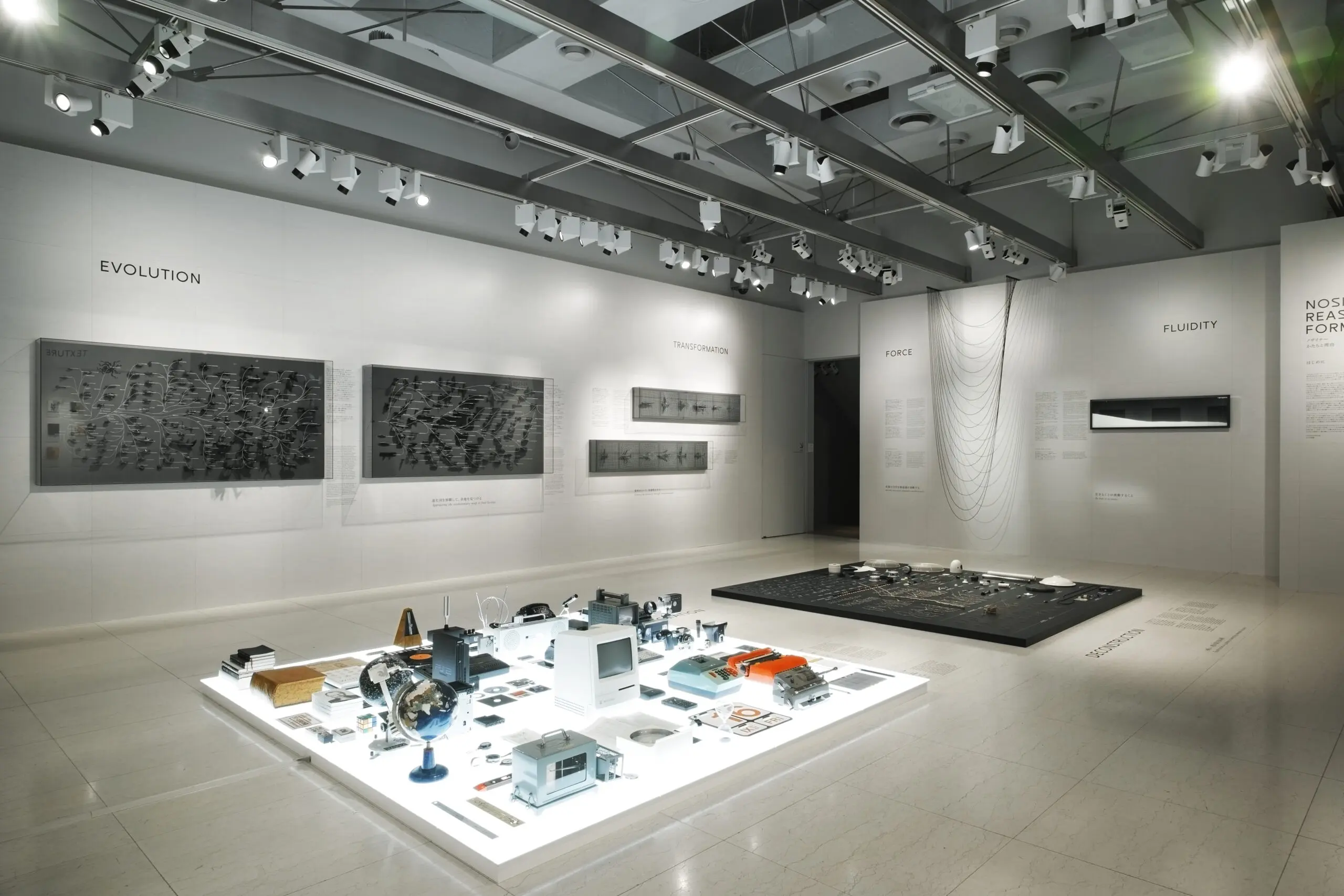
Tachikawa, who had become interested in the creativity of natural forms—which possess no language—that surpasses that of humans, began exploring the commonalities between biological evolution and human creativity. In the exhibition “No-Designer: Form and Reason,” held at the Ginza Graphic Gallery (ggg), he presented works that contrasted evolution and creation, delving into the reasons behind forms and methods for conceiving design.
2012 Began teaching the course “The Grammar of Design”
After entering the workforce and fully committing to his career as a designer, Tachikawa began teaching “The Grammar of Design” at Musashino Art University, a course that expanded upon the content of his master’s thesis. The course, which later expanded to include sessions for working professionals, gained a strong reputation, leading to its adoption at the University of Tokyo’s i.school and its application in innovation initiatives at various companies.
2006: Wrote Master’s Thesis “Linguistic Cognition of Design”
The origins of Evolutional Creativity lie in Tachikawa’s master’s thesis, “Linguistic Cognition of Design,” which he completed while studying architecture as a graduate student. Focusing on the process by which ideas and concepts emerge—a topic he had long been interested in—the thesis examined this process from a linguistic perspective, based on the assumption that language serves as the trigger for inspiration.

INFORMATION
- What
- Evolutional Creativity
- When
- 2016-
- Where
- Japan
- Scope
- Branding / Branding Strategy / Logo / Edition / Business card / Motion logo / Promotional items / Infographics / Photograph / Book cover and inner page design / Exhibition / Poster / Concept Development
- Award
- The 30th Shichihei Yamamoto Prize2021
- ITB GANESHA WIDYA JASA ADIUTAMA2024
- SDGs




CREDIT
- Inventor
- Eisuke Tachikawa
- Thanks
Amanokaze (kazetotuchito Inc. ),Eiji Press Inc. , NOSIGNER staffs,Ginza Graphic Gallery , Yuichi Hisatsugu, Kunihiko Sato