PROJECT
CREATIVIDAD EVOLUTIVA
Metodología creativa que aprende de la evolución biológica. Adoptada por más de 70 empresas y universidades, ganadora del Premio Yamamoto Shichihei. Traducida al chino, coreano e indonesio, expandiéndose globalmente.
HOW
Sistematizando la educación de la creatividad usando la evolución biológica.
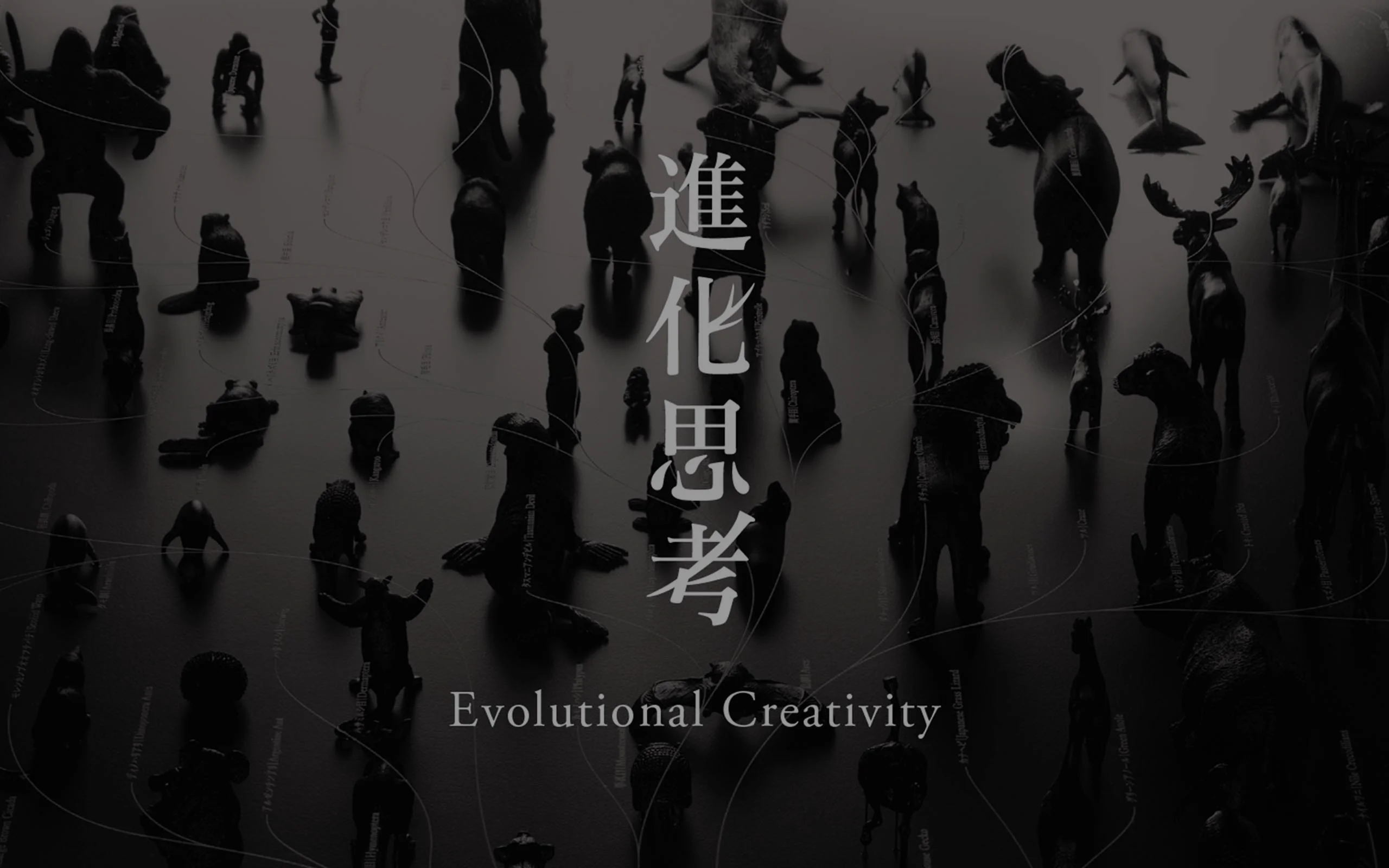
La creatividad humana es tan especial que puede llamarse un fenómeno paranormal en el mundo natural. Entre las decenas de millones de especies en los 3.8 mil millones de años de historia de la vida en la Tierra, no hay otras especies que hayan demostrado nuestro nivel de creatividad. Dado que los humanos también somos parte de la naturaleza, nuestra creatividad también debería considerarse un fenómeno natural.
Mientras tanto, cuando observamos las formas y figuras en la naturaleza, podemos pensar que la naturaleza es aún más creativa que los humanos. ¿Por qué es esto?
Desde esta perspectiva, Eisuke Tachikawa, el director de NOSIGNER, piensa que la creatividad humana es un fenómeno similar a la evolución de los seres vivos. Ha continuado tratando de estructurar la creatividad basándose en la evolución natural. De esta manera ha desarrollado la Creatividad Evolucionaria, un método de pensamiento creativo sistematizado que aplica el funcionamiento de la evolución de los seres vivos al diseño y la innovación.
Los seres vivos evolucionan mediante mutaciones que ocurren por coincidencia y mediante selecciones que ocurren por necesidad debido a factores ambientales y otras condiciones. Estos dos procesos se repiten genéticamente durante generaciones.
Si nuestra creatividad funciona de la misma manera, entonces muchas de las invenciones e innovaciones de la humanidad que han revolucionado el mundo pueden atribuirse a estos procesos alternantes causados por la coincidencia y la necesidad. No hay intención consciente en ambos procesos, el coincidental y el necesario. Los dos procesos simplemente se alternan entre sí para acercarse más a la adaptación óptima.
La creatividad es algo que ocurre de manera autónoma sin depender de la intención consciente del creador. Basándose en esta idea, la Creatividad Evolucionaria es el proceso de alternar entre ideas Mutadas nacidas de coincidencias locas y no convencionales e ideas Selectivas nacidas de la necesidad de adaptarse a las condiciones actuales. Este proceso de creatividad alternante continúa durante generaciones.

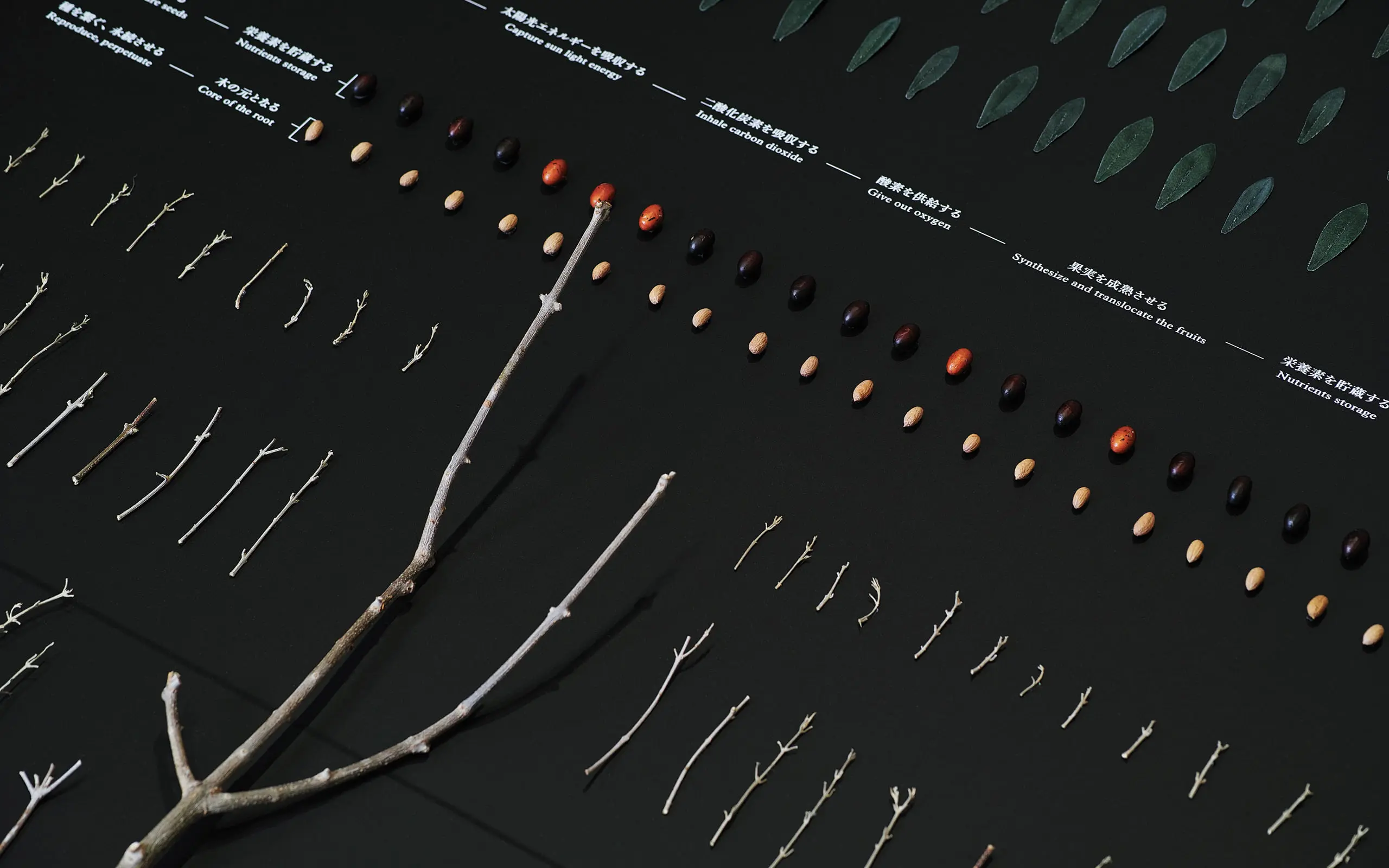
Tachikawa ha estado estudiando la conexión entre el diseño y el lenguaje, y él cree que la fuente de la creatividad humana proviene del lenguaje. Y la clave para la evolución de los seres vivos es la mutación del ADN que es muy similar al lenguaje.
Los errores de copia del ADN pueden compararse con la pronunciación incorrecta y los malentendidos del lenguaje. Basándose en esta suposición, Tachikawa teoriza que la evolución y la creatividad producen patrones similares de mutación.
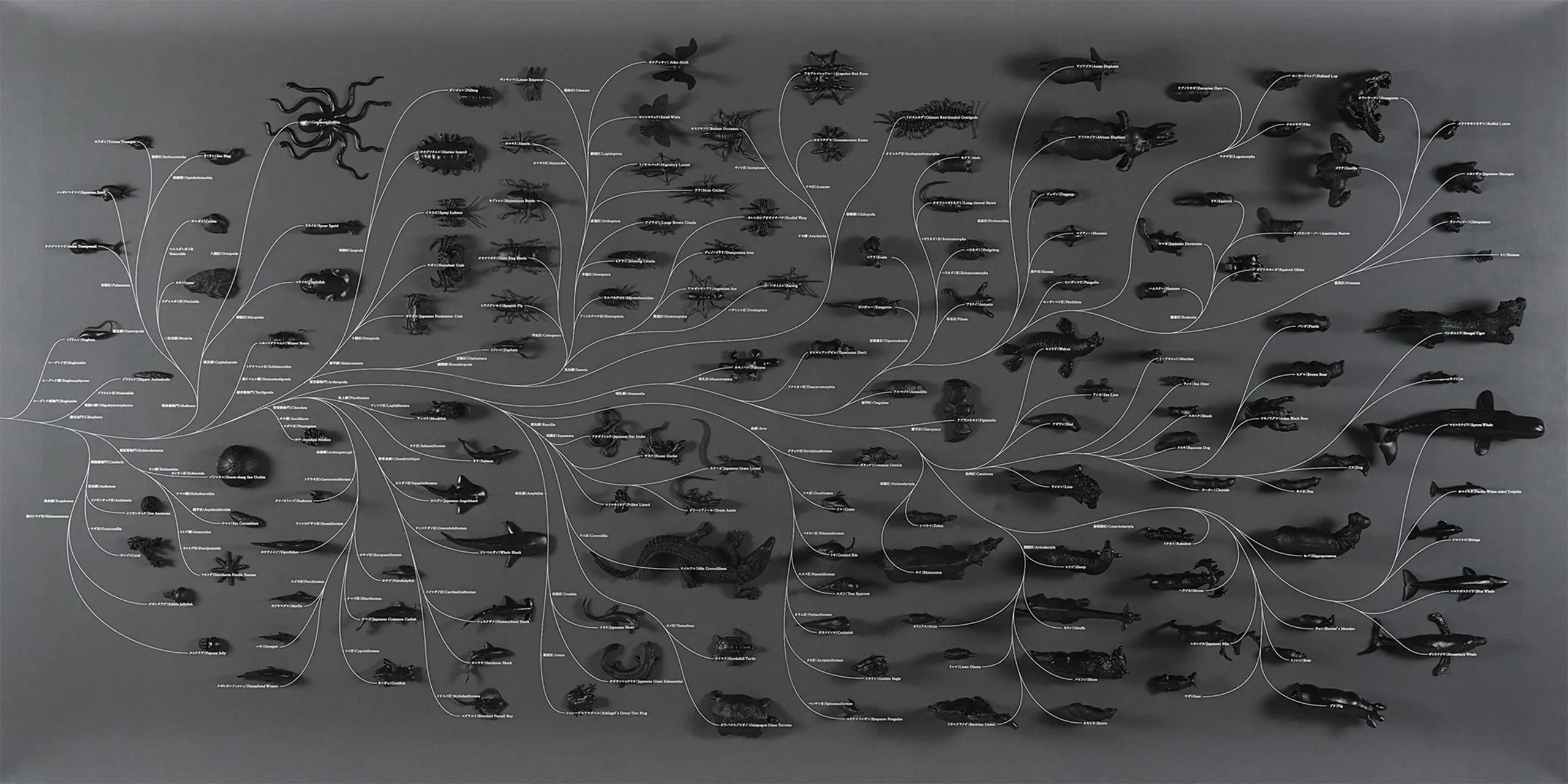
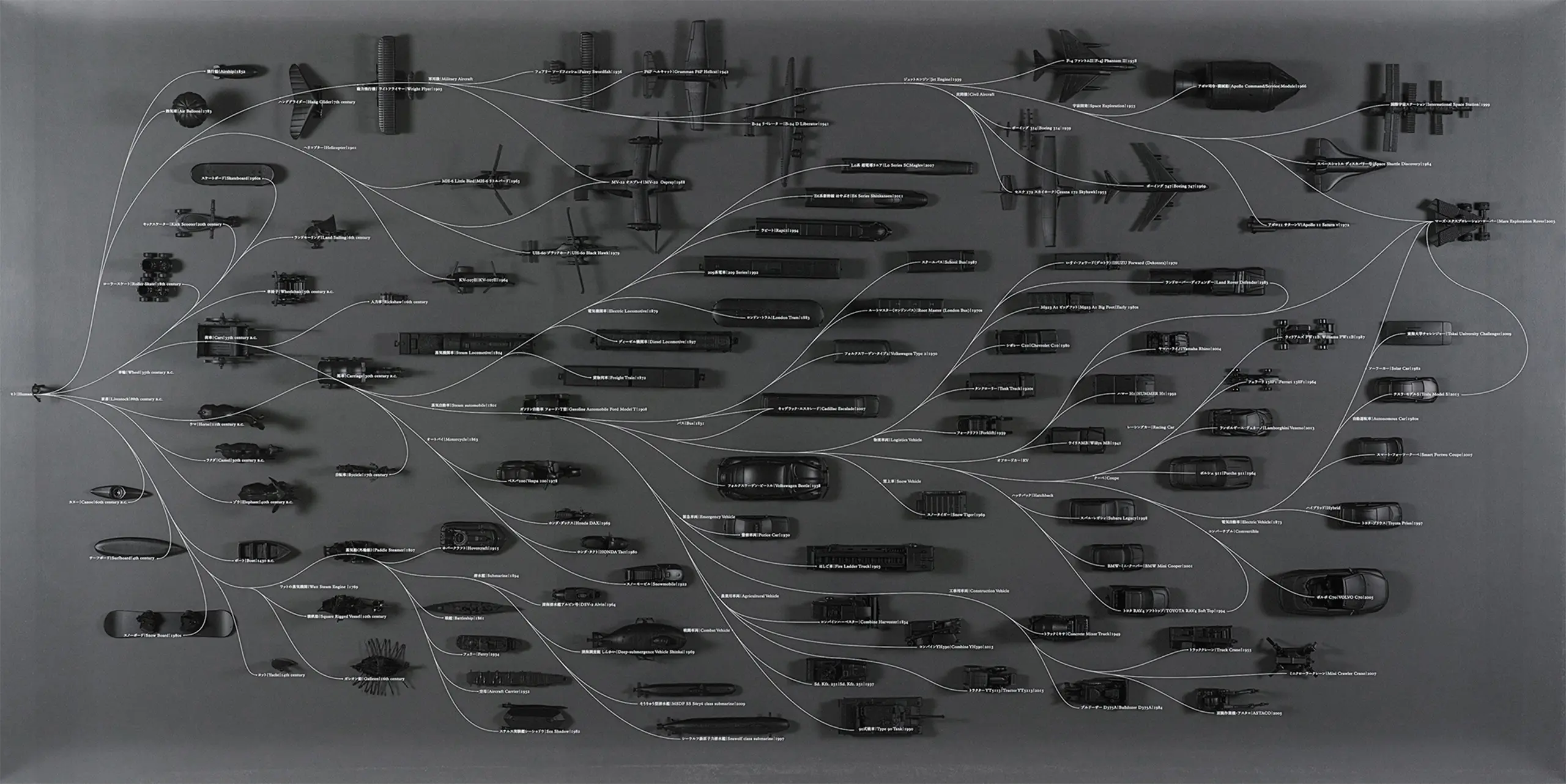
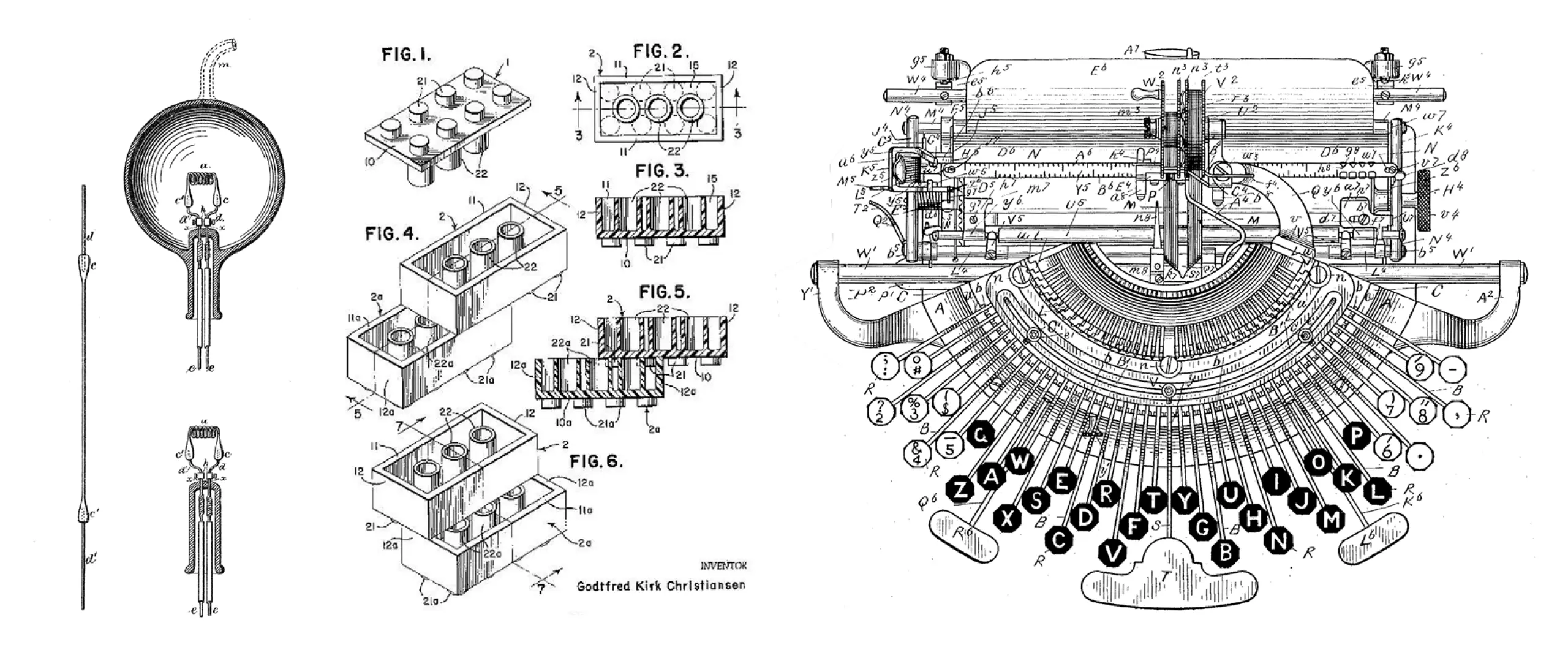
Patrones similares encontrados en la evolución de los seres vivos también son evidentes en diversas invenciones y culturas humanas. La Creatividad Evolutiva aplica estos patrones similares al proceso creativo. Los errores que resultan en nuevas ideas se categorizan en nueve tipos.
Al usar los nueve patrones de mutación de Variar, Desaparecer, Integrar, Invertir, Separar, Sustituir, Asimilar, Transitar y Proliferar como herramientas de una caja de herramientas, podemos generar una gran cantidad de errores coincidenciales para crear muchas ideas en poco tiempo. Estas son ideas mutadas.
Entonces, ¿cómo seleccionamos una buena idea de estos tipos de errores? En el mundo natural, podemos observar cómo los seres vivos hacen selecciones para adaptarse a su entorno. Si aprendemos del enfoque largamente refinado del científico natural para observar el mundo natural, podríamos ser capaces de seleccionar ideas adaptativas.
Mientras estudiaba diferentes métodos de observación en las ciencias naturales, Tachikawa notó que había solo cuatro perspectivas que abarcaban tanto el tiempo como el espacio. Cada una era un sistema de observación biológica establecido.
Las cuatro perspectivas son Anatomía para entender las partes internas, Ecosistema para entender el ambiente externo, Linaje para entender el desarrollo de la genealogía, y Predicción para contemplar el futuro con los dos enfoques de Pronóstico y Pronóstico Inverso. Él sistematizó estos cuatro métodos Adaptativos y los nombró Aprendizaje Espacio-Temporal. Al analizar las condiciones a través de estas cuatro perspectivas que abarcan tiempo y espacio, podemos entender cómo la sociedad es presionada para tomar las decisiones inevitables que toma. Entonces podemos contrarrestarlas en consecuencia seleccionando ideas sólidas.
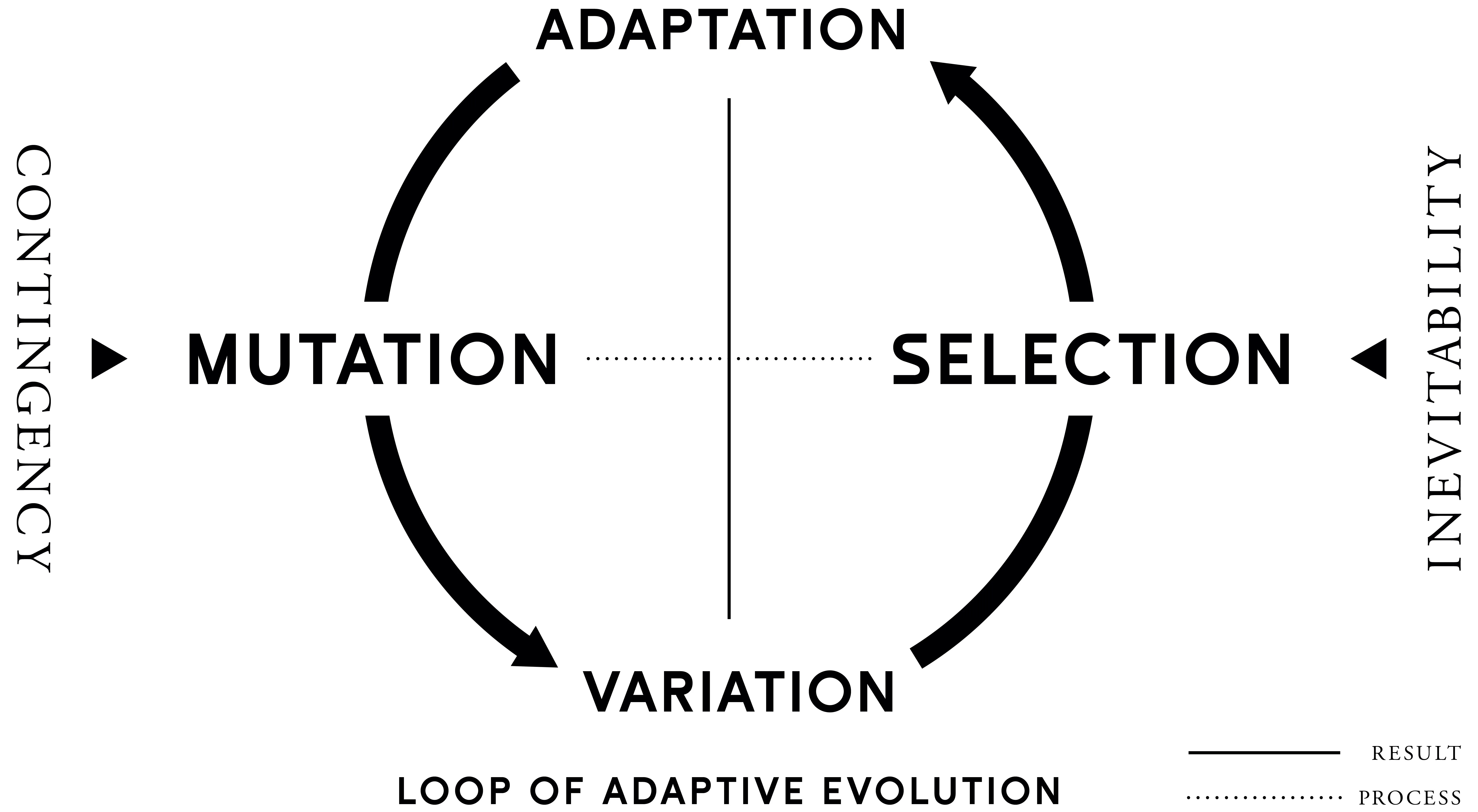
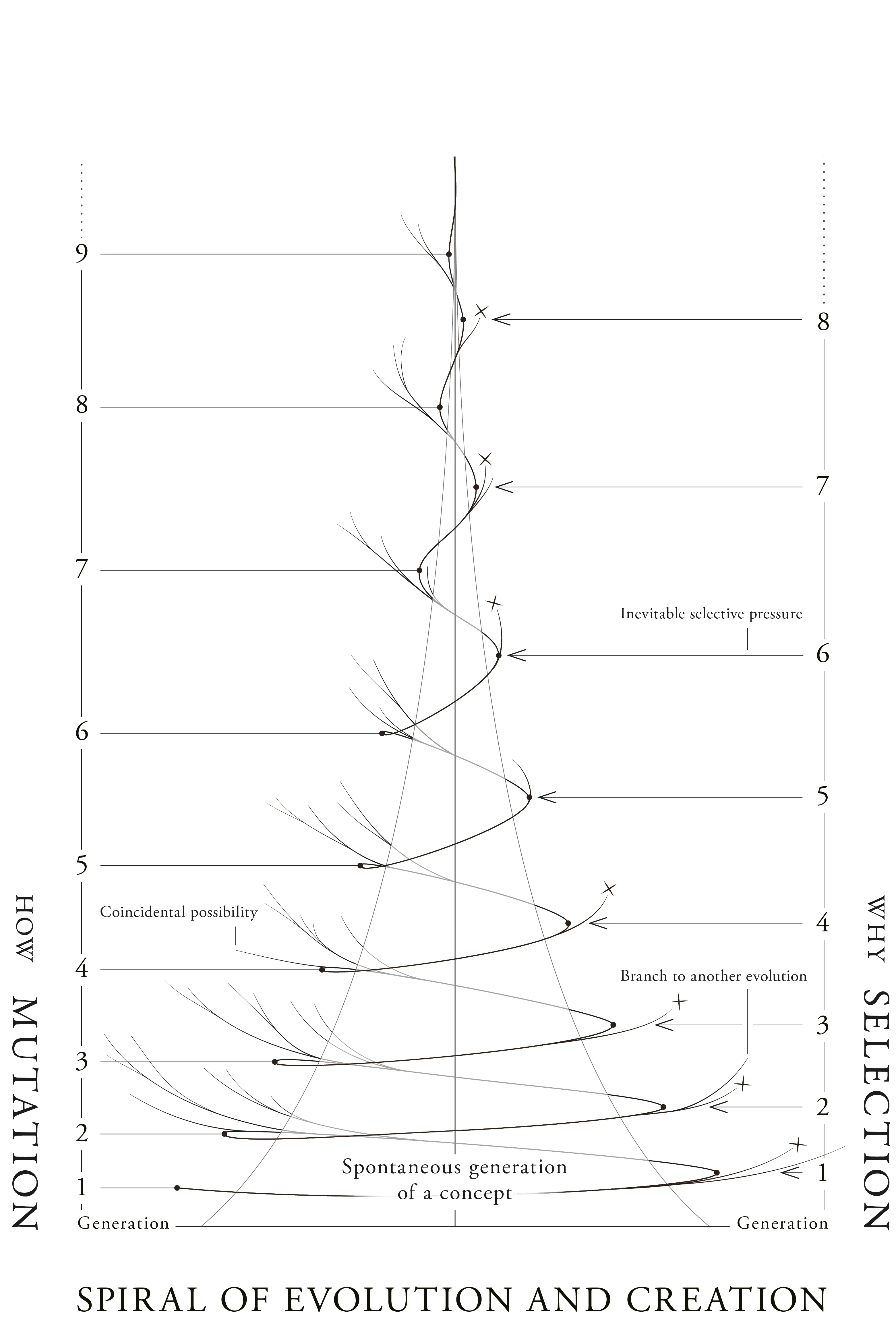
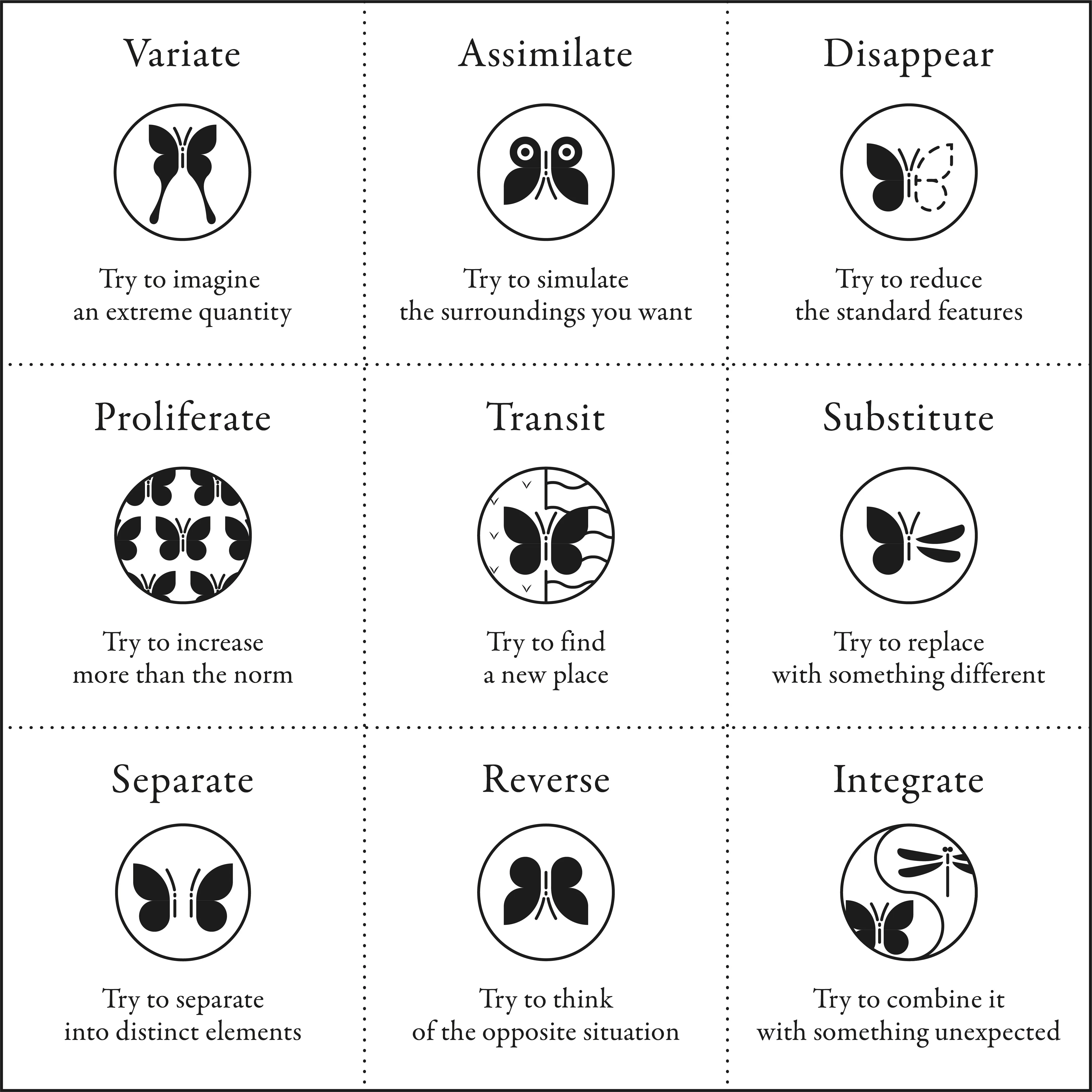
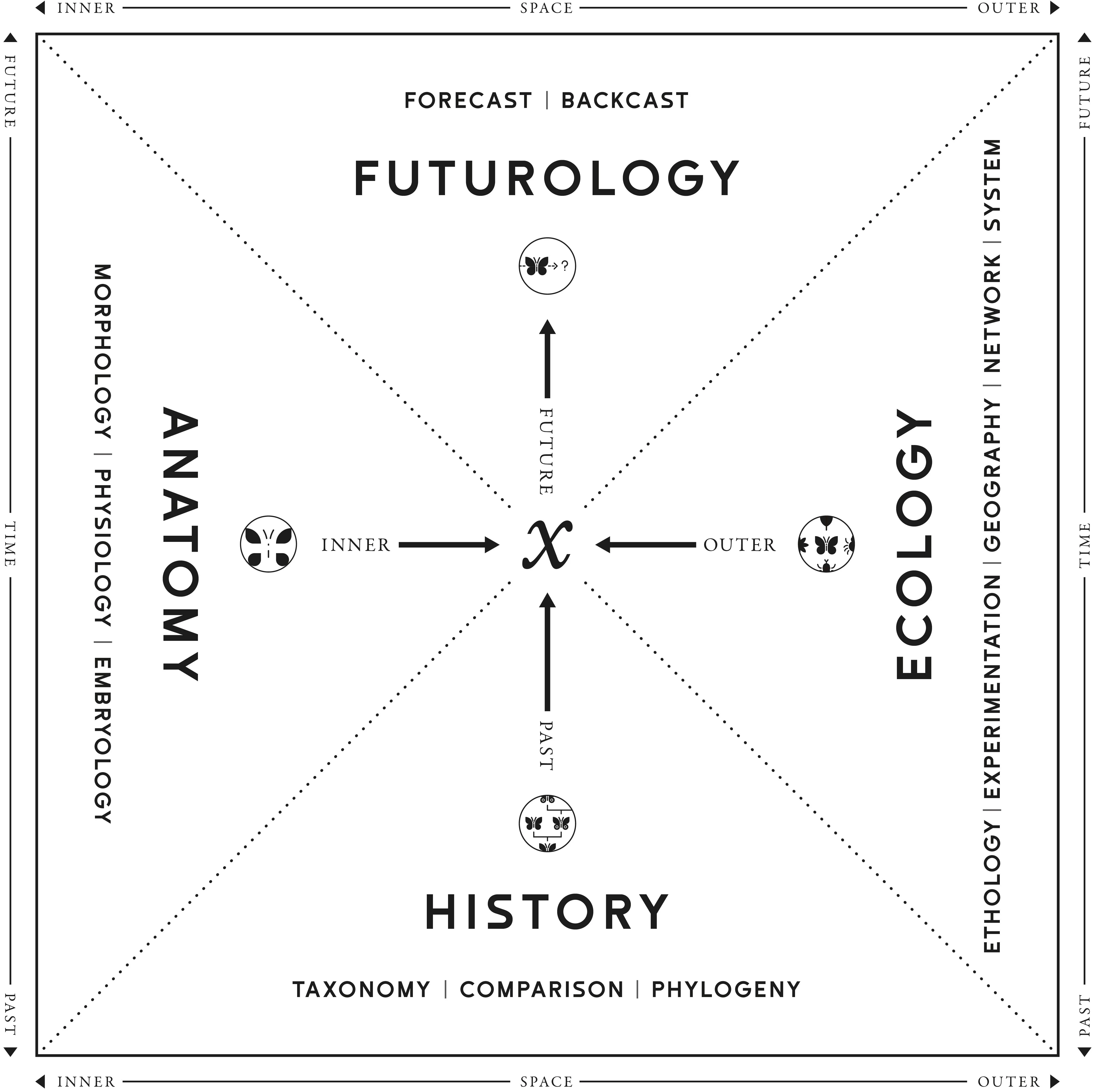
La Creatividad Evolutiva es una forma de pensar para conjurar conceptos creativos que puedan sobrevivir durante mucho tiempo mientras se usan y alternan entre las dos ideas de Mutación y Selección.
(La primera edición del libro Creatividad Evolutiva utilizó la expresión "mutación y adaptación" en referencia a la mutación coincidental y la selección natural dirigida hacia la adaptación. Sin embargo, la edición revisada ha cambiado la expresión a "mutación y selección" para estar más en línea con la corrección académica.)
En abril de 2021, Evolutional Creativity salió a la venta como el primer libro publicado por Amanokaze, la primera editorial fundada en Ama, Prefectura de Shimane, en una isla remota con una población de aproximadamente 2,000 habitantes cerca de la frontera nacional. A pesar de ser publicado en una ubicación remota, el libro se convirtió en el bestseller número 1 de Amazon Japón en la categoría de Negocios & Economía. En una semana desde su lanzamiento, vendió 30,000 copias en tres impresiones. Las ventas del libro han continuado expandiéndose ampliamente.
El libro también ha ganado numerosos premios en Japón. Uno de ellos fue el Premio Yamamoto Shichihei, un prestigioso premio académico otorgado una vez cada pocos años a libros de humanidades que representan a Japón. El comité de selección consistió en dos biólogos (el anatomista Takeshi Yoro y la bióloga evolutiva Mariko Hasegawa), el economista de ciencias sociales Motoshige Ito, el politólogo Terumasa Nakanishi, y el académico legal Hidetsugu Yagi. El libro recibió aclamación académica más allá de las humanidades y las ciencias.
Con Evolutional Creativity, queremos demostrar que podemos cambiar el mundo incluso desde una ubicación remota. También queremos difundir este nuevo programa de educación en creatividad al mundo.
VOICE
La evolución sigue una variedad de leyes reconocidas. El autor se basa en estas leyes como fundamento, con el objetivo de proporcionar material de referencia valioso para la llamada innovación.
Aunque los detalles específicos de cada caso se exploran mejor leyendo el libro en sí, la originalidad de la idea—aplicar principios evolutivos al pensamiento sobre la innovación—supera con creces la de una guía típica de "cómo hacer". Los ejemplos presentados en cada sección son vívidos y atractivos, haciendo que el libro sea agradable de leer. Esto refleja el pensamiento continuo e incansable del autor.
Los 3,5 mil millones de años de evolución biológica en la Tierra nos han llevado a nosotros, moldeando quiénes somos hoy. Si ese proceso fue guiado por ciertas leyes, no hay razón por la cual esas mismas leyes no puedan servir como referencia para los procesos que están por venir.
El enfoque del autor es esencialmente analógico. Konrad Lorenz, el etólogo, una vez comentó en su conferencia del Premio Nobel que su método era puramente analógico. En el mundo académico, que a menudo enfatiza la "originalidad", pocos lo admitirían. Sin embargo, en contextos donde se valora la originalidad—como en la innovación—la importancia de la analogía se vuelve clara. En este sentido, esta obra es altamente valiosa y merecedora del Premio Yamamoto Shichihei.
Instituto de Investigación Yoro, Ltd. /
Profesor Emérito, Universidad de Tokio
Takeshi Yoro

Acerca del Diseño de Libros
El libro fue diseñado por Tachikawa, el propio autor.
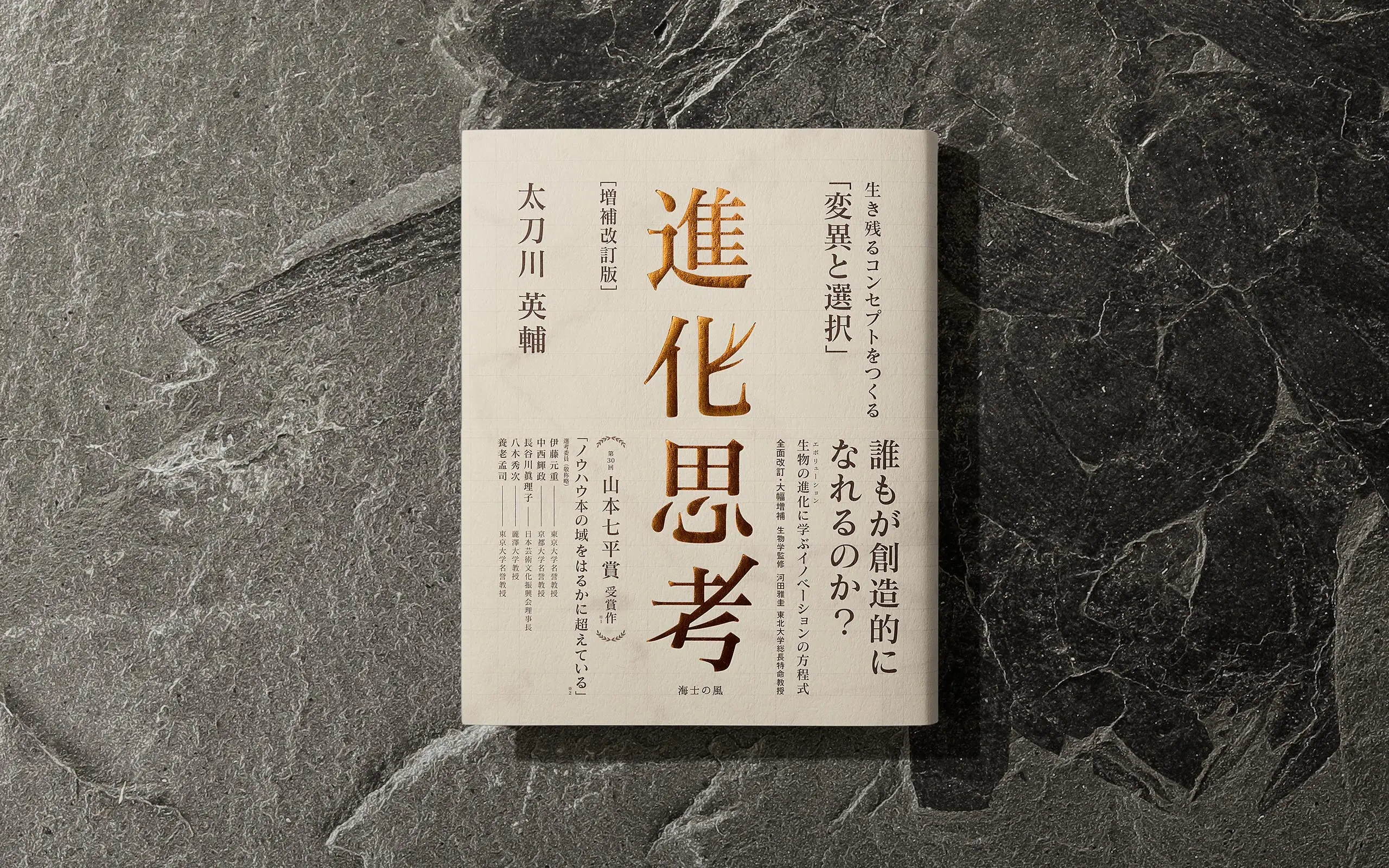
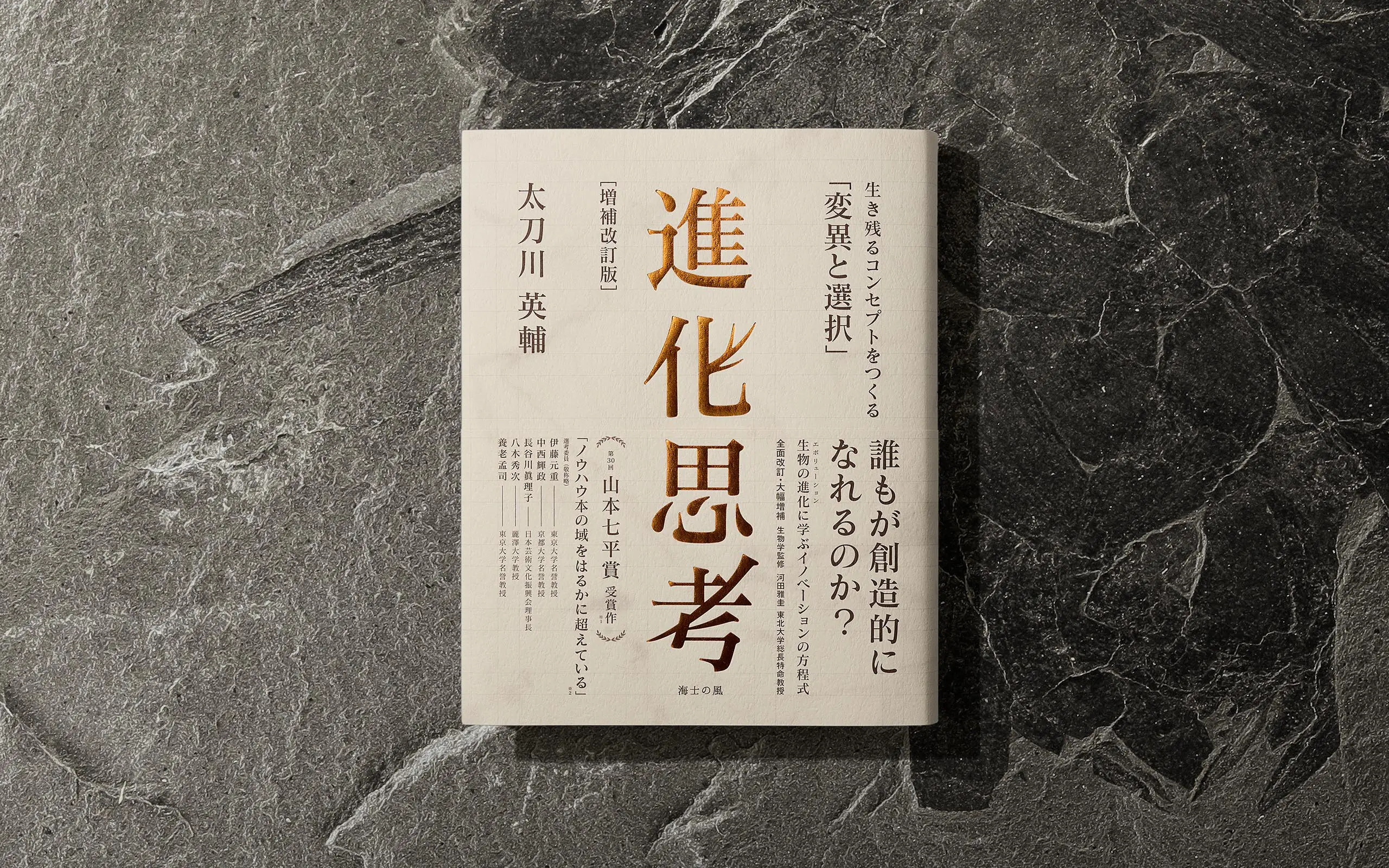
Quería que el libro siguiera siendo querido más allá de los tiempos actuales. Inspirado por los estratos geológicos acumulados durante eones, decidió un diseño y textura similar a la roca. También fue un tributo a la investigación geológica de James Hutton, quien influyó en la Teoría de la Evolución de Charles Darwin.
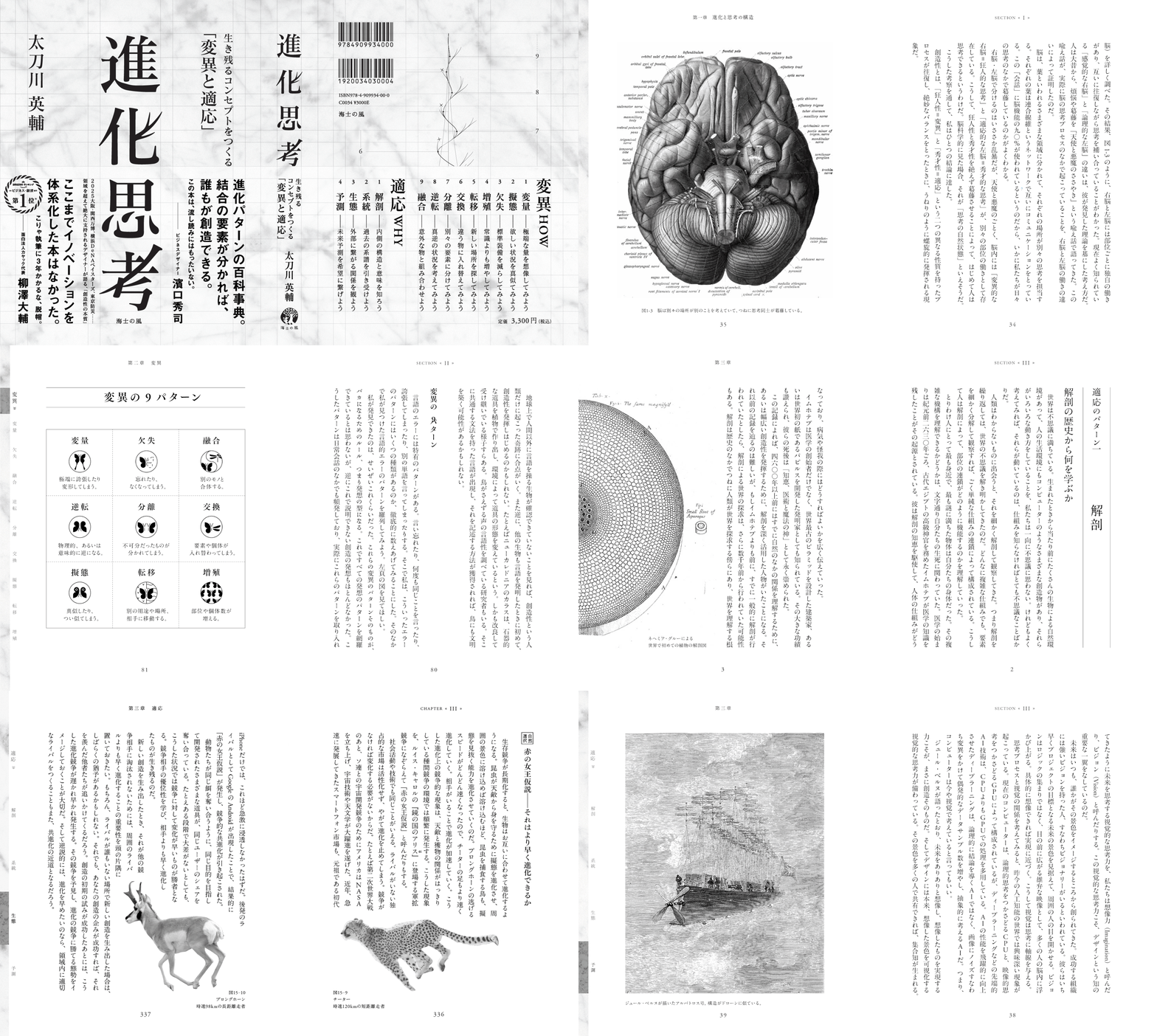
La portada del libro utiliza un papel con patrón en relieve (llamado "Iwa-hada" o superficie rocosa) con una textura similar a la roca, sobre el cual se imprime un patrón de mármol. Como los bordes del libro también tienen el mismo patrón de mármol, el libro de más de 500 páginas parece un ladrillo de piedra grueso y sólido. Además, al eliminar los elementos decorativos tanto como sea posible y tener un diseño minimalista, se mantiene un tono de color uniforme. Es un diseño de libro atemporal y atractivo que no se ve influenciado por ninguna tendencia de diseño.
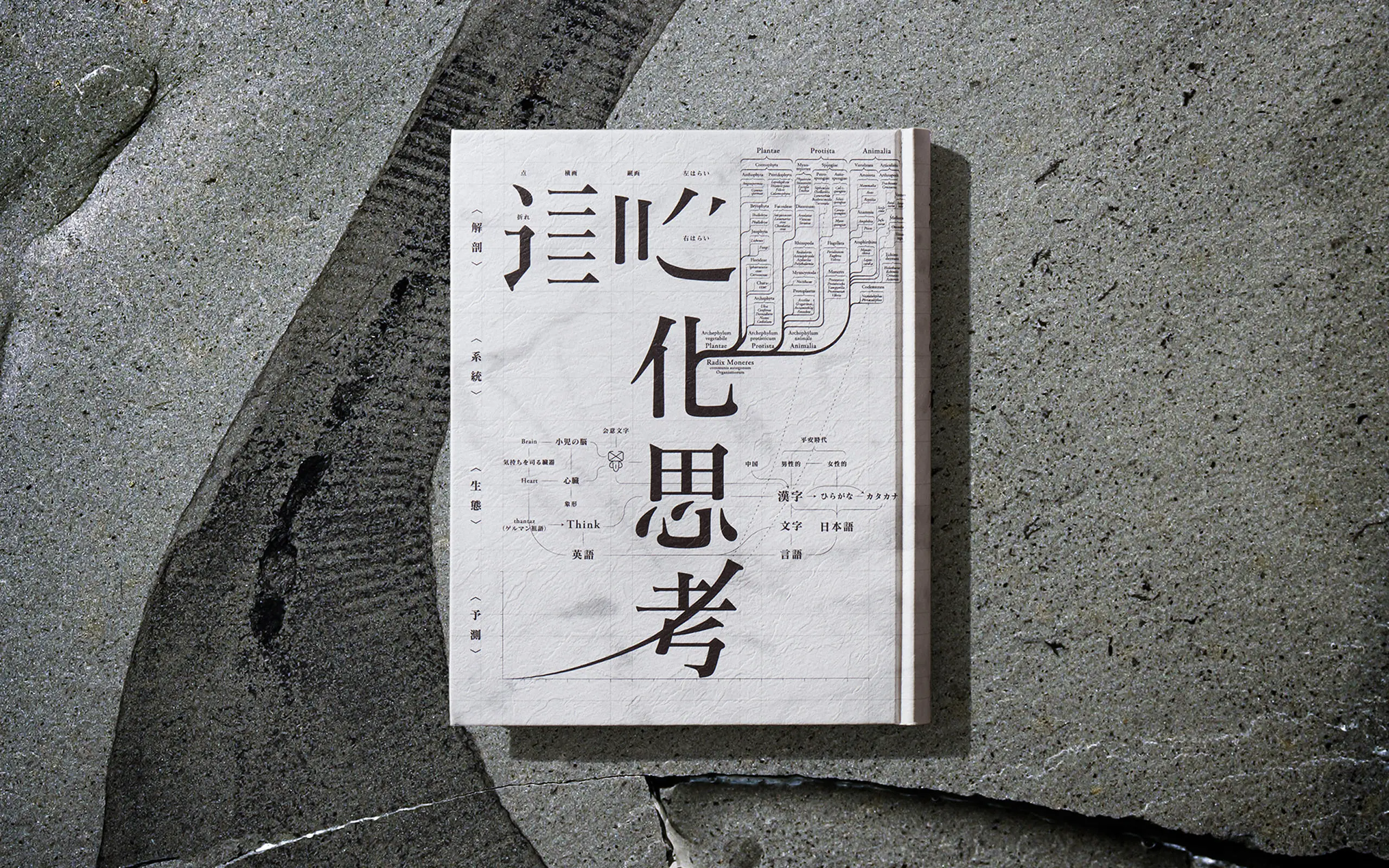
El logotipo del título del libro muestra los cuatro caracteres kanji (進 化 思 考) en transición basado en los patrones de mutación de Creatividad Evolutiva de Proliferar, Asimilar, Revertir y Variar. Cuando se retira la cubierta de papel, la portada del libro muestra los mismos cuatro caracteres kanji como representaciones visuales de las cuatro ideas del aprendizaje espacio-temporal: Anatomía, Linaje, Ecosistema y Predicción.
El logotipo impreso puede verse negro cuando se mira directamente desde arriba, pero aparece marrón cuando se mira desde un ángulo. Este efecto fue creado a través del papel de estampado en caliente "marrón café" de la Compañía Murata Kimpaku y está diseñado para verse como joyas débilmente brillantes incrustadas en el mármol.

Como Tachikawa es tanto el diseñador del libro como el autor, pudo diseñar efectivamente la composición tipográfica del contenido principal utilizando texto envolvente para integrar las ilustraciones en el texto. El índice del libro también tiene un patrón de mármol para facilitar la búsqueda de temas y la relectura del texto.
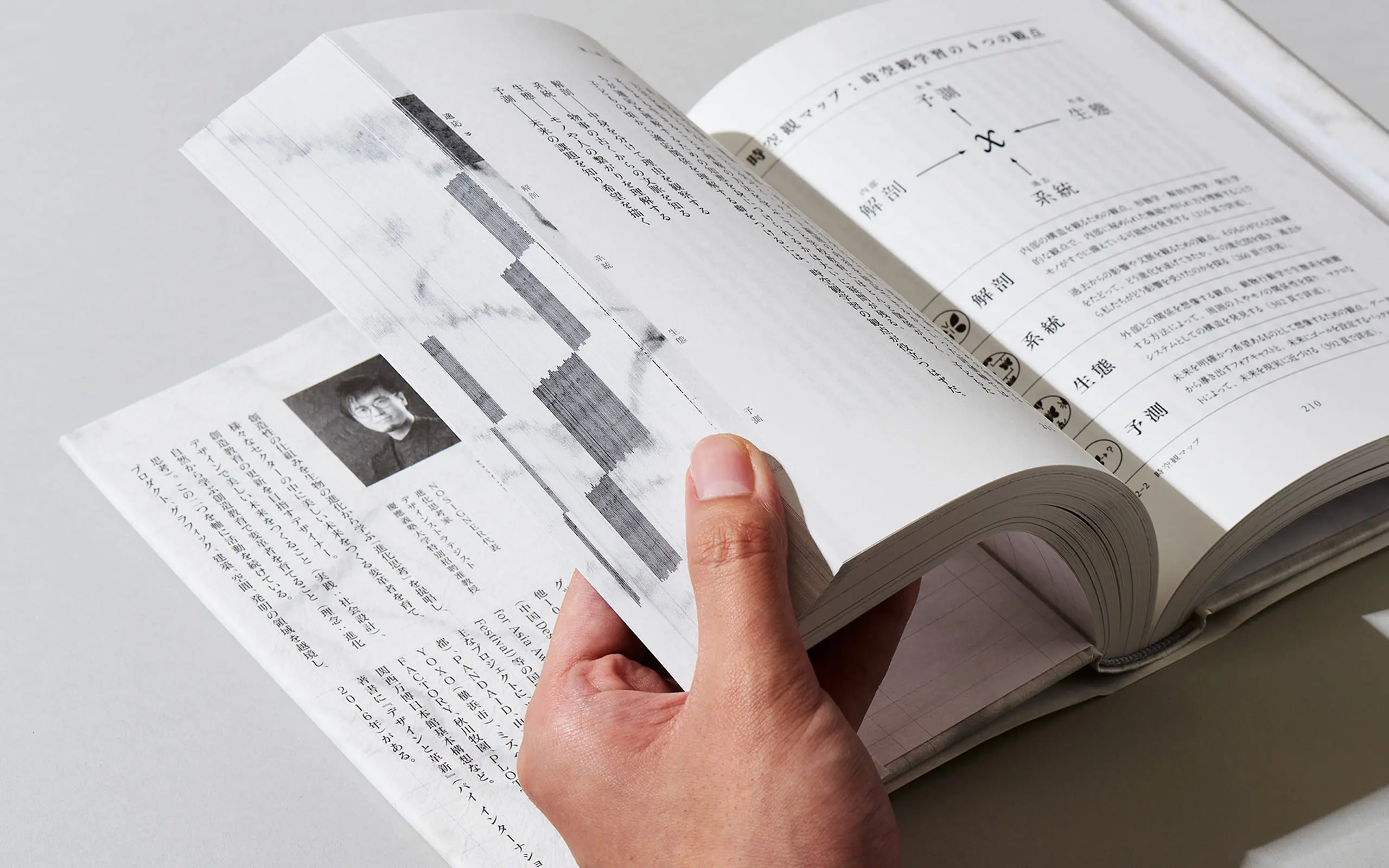
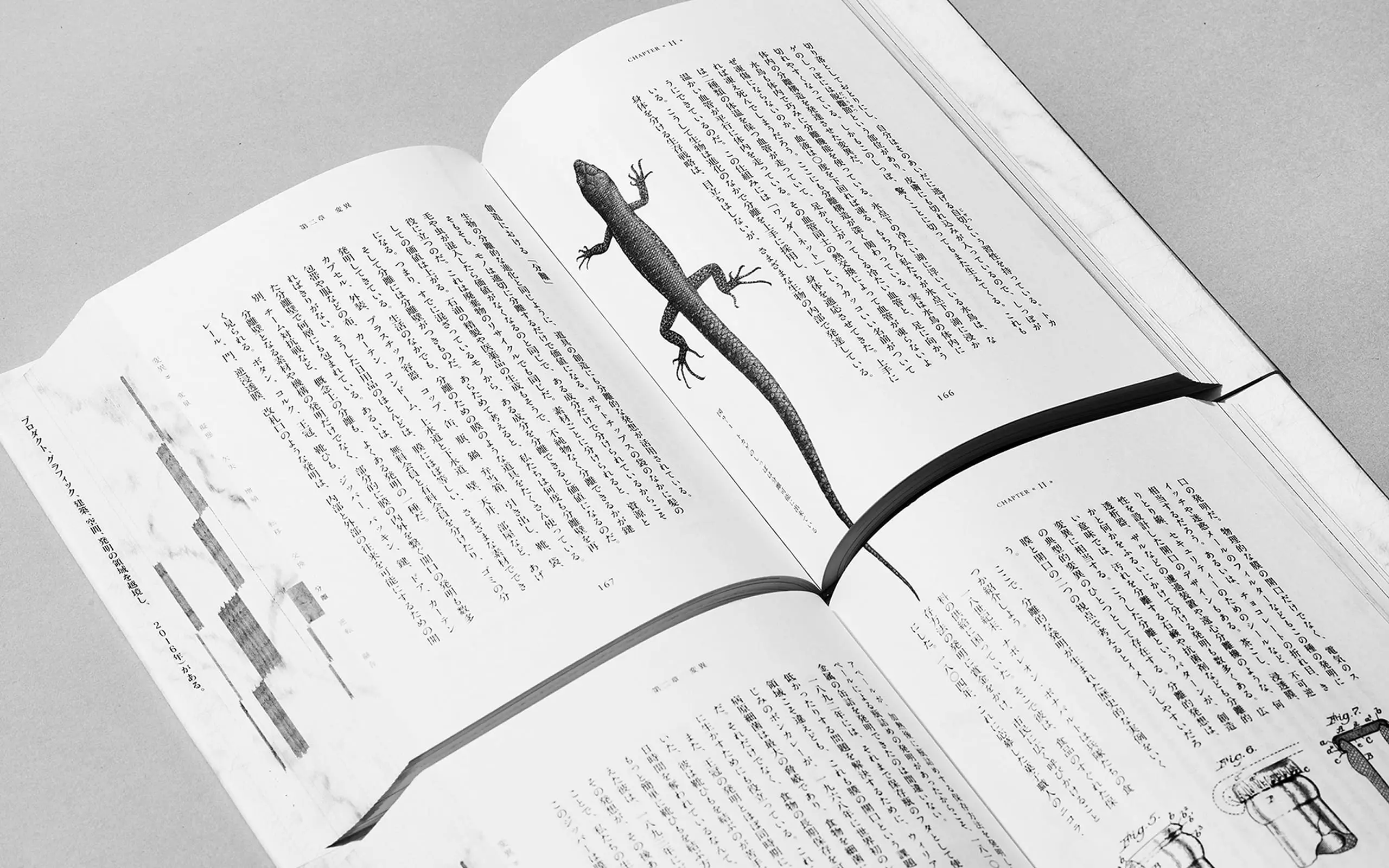
Aprovechando el hecho de que el libro se originó a partir de talleres de creatividad en empresas y universidades, incluye 50 talleres que fomentan el pensamiento creativo. En lugar de ser solo un libro de texto para leer, también puedes probar y poner en práctica tus ideas creativas. A pesar de que el libro tiene más de 500 páginas, es fácil de leer y fácil de usar. Puede utilizarse como una referencia frecuente o enciclopedia para consultar temas de "creatividad" y "evolución biológica".
WHY
¿Es la creatividad algo limitado a aquellos con talento?
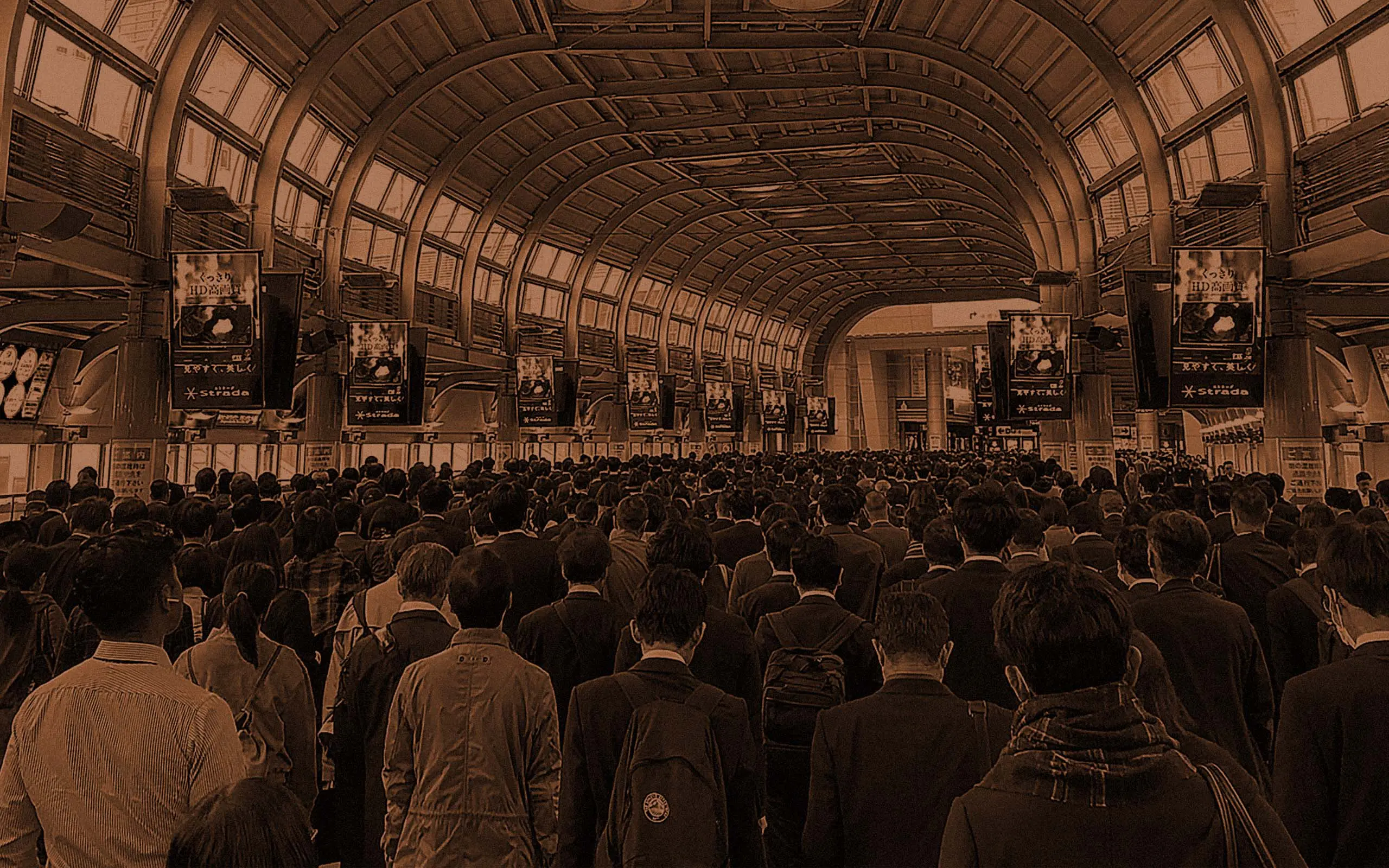
En la búsqueda de nuestros deseos, los humanos nos hemos vuelto creativos e inventado todo tipo de herramientas, contribuyendo así al desarrollo de nuestra civilización. A pesar de su importancia, la creatividad ha sido comúnmente considerada como una habilidad innata que requiere talento natural para manifestarse. ¿Es la creatividad algo que no se puede aprender?
"Inteligencia Cristalizada y Fluida" por Raymond Cattell

Estado de los objetivos individuales de los ODS en el punto medio de la Agenda 2030

Gráfico de estudiantes japoneses que piensan que son creativos

Hay incontables personas que piensan que no tienen talento creativo porque no pintaban bien en la clase de arte, etc. Una encuesta decepcionante encontró que solo el ocho por ciento de los estudiantes universitarios en Japón pensaban que eran creativos.
¿Realmente tenemos un entendimiento profundo de la creatividad? Cuando lo pensamos, podemos darnos cuenta de lo poco que sabemos sobre cómo funciona la creatividad y cómo podemos ser entrenados para ella. Si podemos entender el funcionamiento interno de la creatividad, podríamos ser capaces de adquirirla.
En años recientes, las escuelas han comenzado a pensar en la participación activa de los estudiantes como el aprendizaje activo y el aprendizaje basado en la investigación. Es para fomentar la creatividad y una mente inquisitiva no limitada por el marco convencional de la materia de clase. Incluso en el mundo empresarial, los métodos de pensamiento que estimulan la creatividad están recibiendo más atención.
Si tenemos más personas iniciando proyectos creativos, conduciría a una sociedad más sostenible y soluciones básicas para varios problemas sociales. Para este fin, necesitamos entender la creatividad misma y establecer una teoría y un programa educativo para aprender sistemáticamente sobre la creatividad.
WILL
Actualizando la enseñanza creativa y superando un mundo insostenible.
La Creatividad Evolucionaria ha ganado amplia aceptación y reconocimiento como el método de innovación más poderoso del mundo, habiendo sido adoptado por importantes empresas japonesas e instituciones educativas como Panasonic, Fujitsu, Sumitomo House y la Universidad de Keio. El método incluso ha sido incluido como pregunta en el examen de ingreso para el idioma nacional en la Universidad de Doshisha. A medida que más y más individuos adoptan este pensamiento creativo y producen proyectos transformadores para la sostenibilidad, el alcance de la Creatividad Evolucionaria continúa expandiéndose. Incluso expertos en la IA líder de Japón están incorporando los principios de la Creatividad Evolucionaria en su trabajo, y se han realizado talleres utilizando el método en la exhibición ambiental de animales más grande del país en el zoológico. La Creatividad Evolucionaria está haciendo su camino gradualmente en una amplia gama de campos, y su impacto continuará creciendo.
A pesar del éxito temprano y el reconocimiento de la Creatividad Evolucionaria, la implementación de proyectos educativos verdaderamente creativos que se inspiran en las leyes de la naturaleza aún está en su infancia.
Mientras la humanidad continúa avanzando a través de la tecnología, también estamos enfrentando las consecuencias de cambios drásticos en la geología y el clima, así como el colapso de los ecosistemas. Hemos entrado en el "Antropoceno", una era geológica en la cual la actividad humana tiene un efecto profundo en la tierra. Con nuestra civilización habiendo superado la "frontera planetaria", el punto en el cual el cambio ambiental irreversible y repentino se convierte en una posibilidad real, el tiempo es esencial. Es crucial que implementemos métodos educativos innovadores y efectivos como la Creatividad Evolucionaria para asegurar nuestra supervivencia y allanar el camino hacia un futuro sostenible.


La expresión estrecha de creatividad de la humanidad ha llevado a la crisis del colapso de la civilización, sin embargo, nuestra creatividad sigue siendo nuestro único medio de supervivencia en la tierra. Es esencial que comprendamos la esencia de la creatividad y la usemos al máximo de su potencial para abordar varios problemas y crear una sociedad sostenible. Ahora es el momento para que profundicemos en la comprensión de la creatividad y la apliquemos a soluciones que promuevan la coexistencia entre el ser humano y el medio ambiente.
Friedrich Fröbel, un pionero en la educación infantil temprana que floreció en el siglo XIX, sentó las bases para la educación de la creatividad al inspirarse en las ciencias naturales y ha tenido una influencia significativa en movimientos posteriores como la Bauhaus. Sin embargo, a pesar del trabajo revolucionario de Fröbel y la Bauhaus, la educación de la creatividad se ha mantenido prácticamente sin cambios durante el siglo pasado. Nuestro objetivo es evolucionar y revitalizar este campo de la educación, para mantenernos al ritmo de las necesidades siempre cambiantes de la sociedad y el medio ambiente.
Creemos que al actualizar la educación de la creatividad a través del lente de la Creatividad Evolutiva, podemos empoderar a los individuos para abordar creativamente los problemas sociales urgentes de nuestro tiempo y maximizar la creatividad de cada persona en cada comunidad. Al equipar a los individuos con las herramientas para pensar y actuar de maneras nuevas e innovadoras, podemos trabajar hacia la resolución de los grandes desafíos que enfrenta la humanidad y construir un futuro mejor para todos.
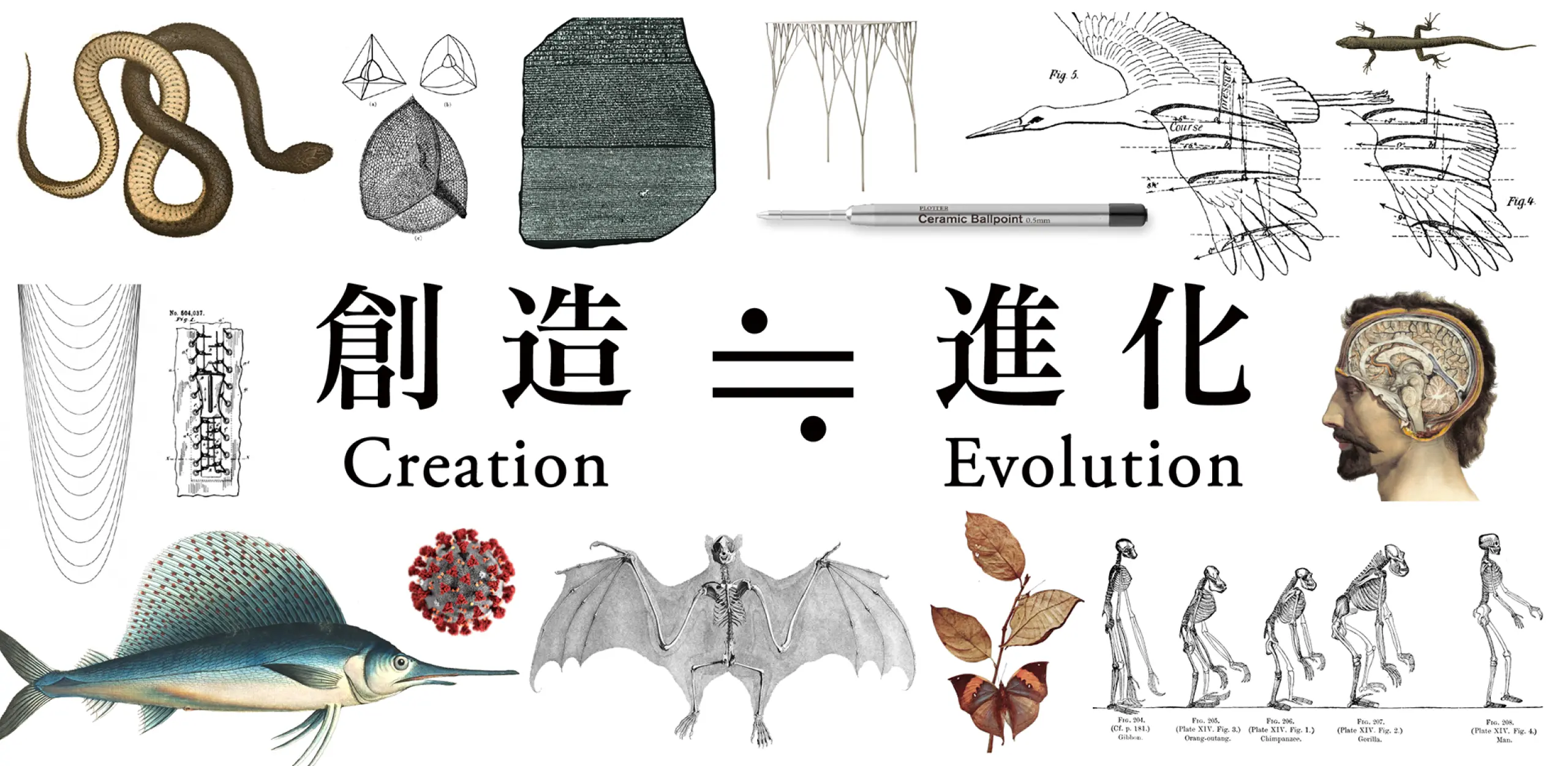

El libro " Evolutional Creativity " fue clasificado como No. 1 en los rankings de libros de negocios y economía de Amazon poco después de salir a la venta en preventa, y fue rápidamente reimpreso antes de su lanzamiento. ¿Qué es esta nueva forma de pensar que despierta la creatividad que yace dormida dentro de todos?
Sitios Relacionados /
The Evolution of “Evolutional Creativity” (Updated November 2025)
November 2025: Keynote Speech at the 9th Leadership Summit 2025 in Bangladesh
Eisuke Tachikawa took the stage as a keynote speaker at the “Leadership Summit 2025” held in Bangladesh. Held under the theme “Resilient Leadership – Thriving Amid Uncertainty,” this international conference explored the sustainable and ethical leadership required in a rapidly changing society. Tachikawa delivered a speech on the nature of leadership in addressing social issues and environmental changes from the perspective of Evolutional Creativity.
November 2025: Online Presentation at the 12th Anniversary Commemoration of Typhoon Yolanda
Marking the 12th anniversary of Typhoon Yolanda—which caused some of the worst damage ever recorded in the Philippines—Eisuke Tachikawa spoke at a commemorative event held at Eastern Visayas State University. He delivered an online lecture on “Evolutional Creativity” to approximately 400 participants, sharing creative perspectives on how to confront disasters.
November 2025: Delivered a Special Lecture to Graduate Students at Minerva University
At Minerva University—known for its unique educational model that involves learning while moving between seven cities worldwide and having been selected as “the world’s most innovative university”—Eisuke Tachikawa delivered a special lecture on “Evolutional Creativity” to approximately 20 graduate students majoring in “Decision Science.” Students from diverse backgrounds, including current politicians and corporate leaders, visited the Yokohama studio of NOSIGNER—the firm led by Tachikawa—and the lecture lasted three hours due to a lively Q&A session.
October 2025: Presentation at the “Cities of Design Subnetwork Meeting” Conference Hosted by the UNESCO Creative Cities Network (UCCN)
Eisuke Tachikawa spoke at the “Cities of Design Subnetwork Meeting” hosted by the UNESCO Creative Cities Network (UCCN)—which aims to harness culture and creativity for sustainable urban development—at the Bandung Institute of Technology. He participated in a panel discussion themed “Creative City 2.0,” exchanging views on approaches to creativity based on “Evolutional Creativity” and the future of cities adapting to climate change.
September 2025: Keynote Speech at the International Design Conference (IDC) 2025 in the Philippines
Eisuke Tachikawa delivered a keynote speech at the International Design Conference (IDC) 2025, organized by the Design Center of the Philippines, the government agency responsible for promoting design in the Philippines. Invited as a keynote speaker to the conference, which featured a diverse lineup of speakers including consultants, designers, researchers, and business executives under the theme “Holding the Whole,” he delivered a keynote address on creativity education based on “Evolutional Creativity” and the ideal form of cities adapting to climate change.
July 2025: Received the Highest Academic Award from Bandung Institute of Technology
He was awarded the “GANESA WIDYA JASA ADIUTAMA Award,” the highest academic honor bestowed by the Bandung Institute of Technology (ITB) in Indonesia for outstanding contributions to knowledge and education. This prestigious award is granted to only two individuals following a rigorous selection process from candidates nominated by each faculty; he was selected based on a nomination from the Faculty of Art and Design (FSRD).
November 2024: Publication of the Indonesian Edition of *Evolutional Creativity*
The Indonesian edition of the book *Evolutional Creativity* was published by the Indonesian publishing house “SiMPUL” under the supervision of the Bandung Institute of Technology (ITB), one of Indonesia’s leading universities.
Additionally, to commemorate the book’s publication, an exhibition and commemorative lecture were held at the ITB Design Center, and an exhibition and workshop were also held at the Jakarta art space “
April 2024: 3rd Anniversary of the Publication of “Evolutional Creativity”
“Evolutional Creativity,” systematized by its proponent, Eisuke Tachikawa, after years of exploration, has continued to evolve even today, having received a wide range of feedback—including support, encouragement, criticism, and suggestions—from many people since the first edition of the book was published.
Furthermore, a reader community formed by over 100 enthusiastic readers remains actively engaged, and the principles of Evolutional Creativity are being put to practical use in the work and daily lives of its practitioners.
March 2024: Lecture at the Ministry of Economy, Trade and Industry for Stanford Business School Students
Tachikawa delivered a lecture on Japanese design and Evolutional Creativity to approximately 30 students and faculty members from Stanford Graduate School of Business at the Ministry of Economy, Trade and Industry. This lecture was part of the school’s study tour to Japan, a program designed to explore the relationship between Japan’s rapid economic growth and design, as well as the current state of startups.
December 2023: Publication of *Evolutional Creativity [Expanded and Revised Edition]*
With biological supervision provided by evolutionary biologist Masaki Kawata (Professor by Special Appointment to the President at Tohoku University),
October 2023: Paper Presentation at the World Design Assembly International Conference
At the
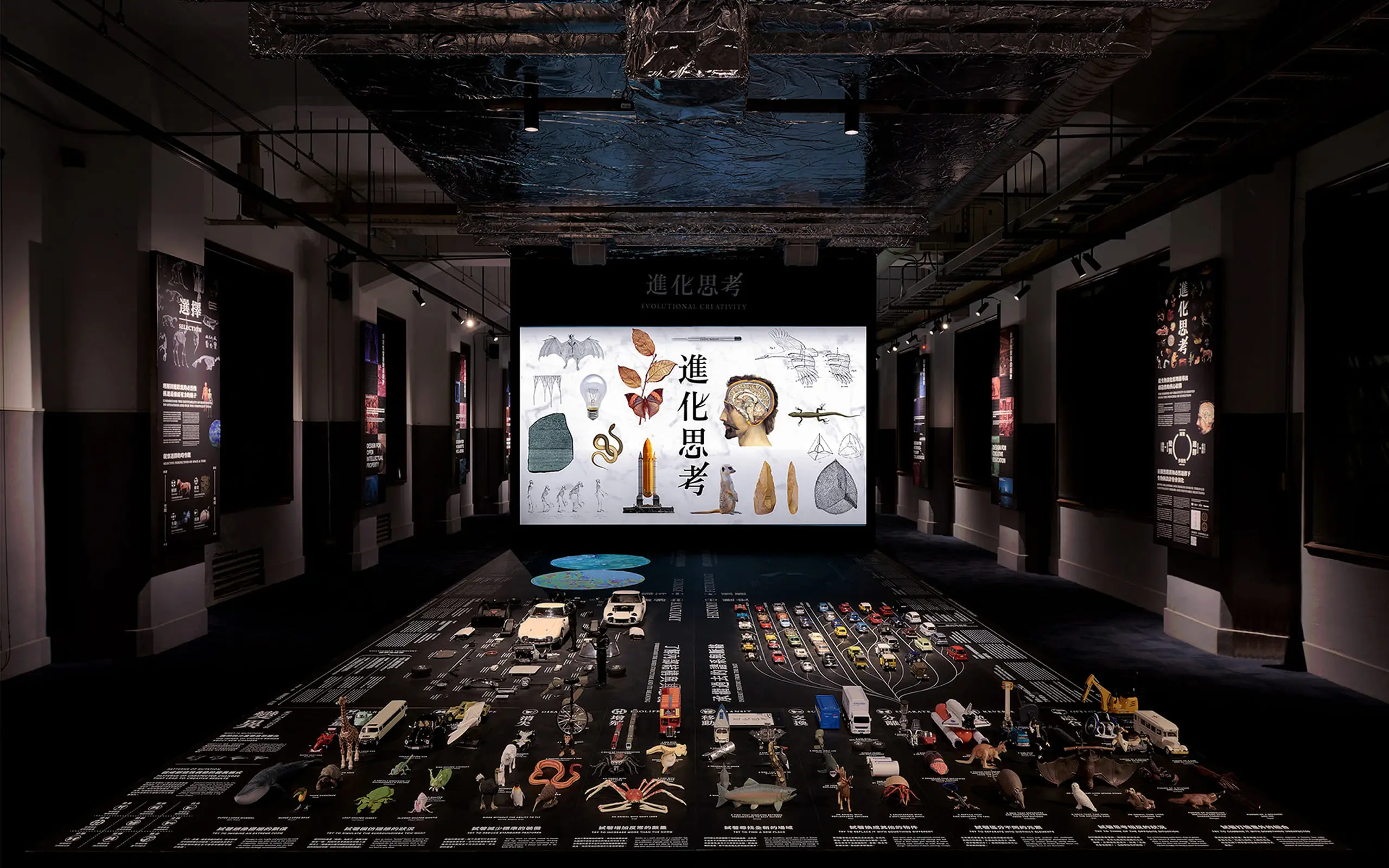
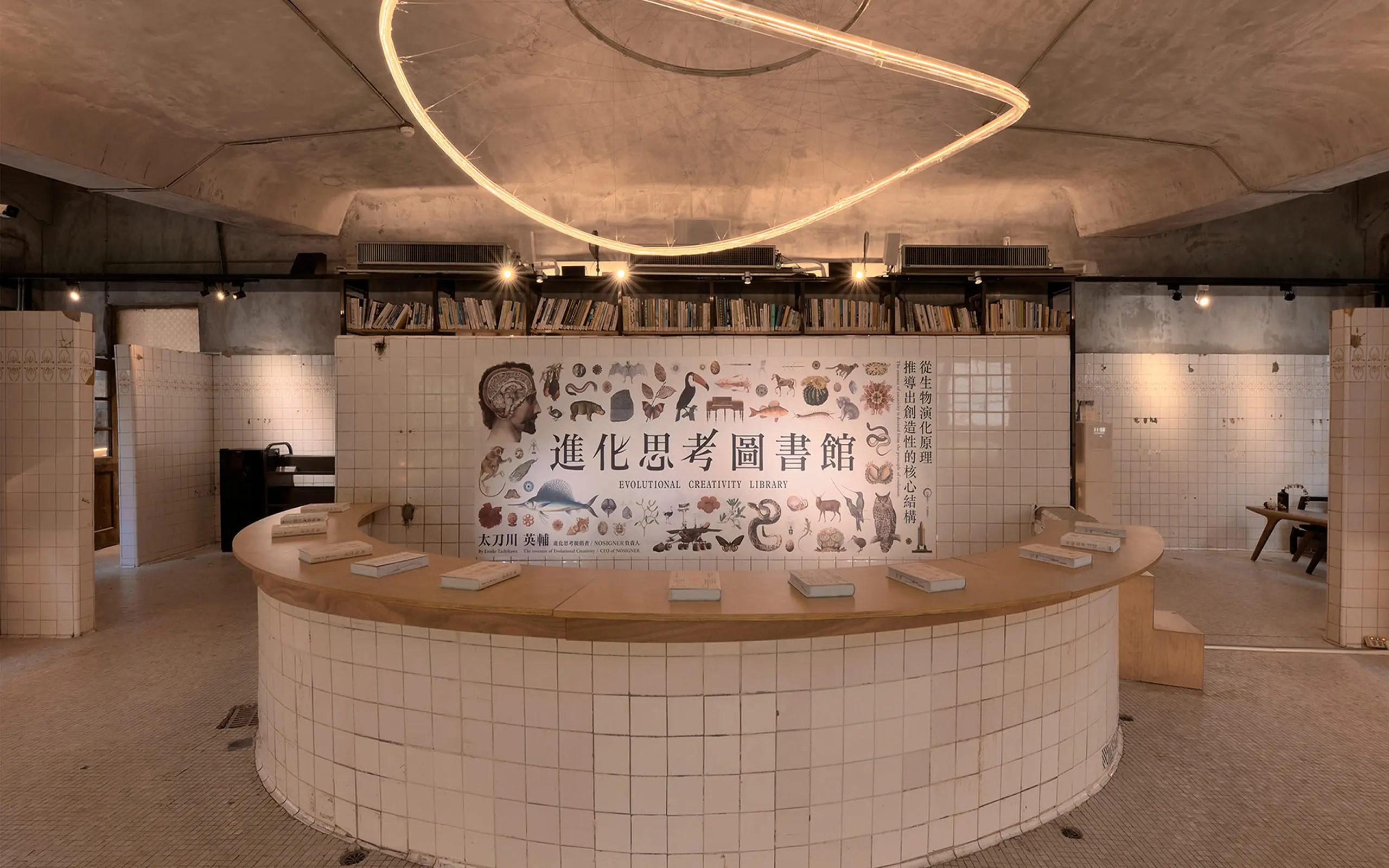
September 2023: Exhibition Held at the Taiwan Design Museum
Coinciding with the publication of the Taiwanese edition of the book *Evolutional Creativity*, an exhibition by NOSIGNER titled
September 2023: Publication of the Taiwanese Edition of “Evolutional Creativity”
Following the Korean edition, the
June 2023: Publication of the Korean Edition of “Evolutional Creativity”
The
May 2023: Presentation at a Conference Hosted by UNESCO-MGIEP
Tachikawa was invited to speak at the conference “Education for Flourishing in a Mixed Reality,” organized by UNESCO-MGIEP (the United Nations Educational, Scientific and Cultural Organization’s Mahatma Gandhi Institute of Education for Peace and Sustainable Development), which brought together renowned scholars, researchers, teachers, policymakers, and representatives from the private sector from around the world. He delivered a presentation on “Evolutional Creativity” during the “Design Thinking and Creativity in Education” session. This conference was also the first international conference based on the Sustainable Flourishing Goals.
March 2023, August 2023: Lecture at the Bandung Institute of Technology (ITB), Indonesia
Tachikawa delivered a lecture on Evolutional Creativity at the Bandung Institute of Technology (ITB), Indonesia’s premier institution of higher learning. Due to the positive reception of this content, it was decided to publish an Indonesian-language edition of “Evolutional Creativity.” Following the
March 2023: Chaired the “Thinking About the Future of Higher Education” Forum
Eisuke Tachikawa served as chair of the “Thinking About the Future of Higher Education” forum, organized by the Benesse Educational Research Institute, where members engaged in cutting-edge educational practices discussed the future of university education. After four rounds of roundtable discussions with committee members, a proposal outlining a vision for university education that envisions a hopeful future was compiled. Under the new educational guiding principle, “
November 2022: Received the “Shu Yamaguchi Award” at the Pen Creator Awards
Eisuke Tachikawa received the “Shu Yamaguchi Award” at the “
November 2022: Appeared in an NHK program for a dialogue with anatomist Takeshi Yoro
He appeared alongside anatomist Takeshi Yoro on the popular NHK program “Switch Interview,” in which two people working in different fields visit each other’s workplaces and conduct a dialogue while “switching” between the roles of speaker and listener. In the second part of the program, I invited Dr. Yoro—who has spent nearly 60 years since his student days exploring “the forms of living things”—to the NOSIGNER studio. While introducing the concept of “Evolutional Creativity,” I spoke about my work as a designer who has pursued form through various approaches.
June 2022: Project to Launch Revised Edition of
A project to publish a revised edition has begun, aiming to further refine the book as a method of creative thinking and accurately incorporate scientific insights. For this revision, we invited Professor Masaki Kawata, a professor on special assignment to the President at Tohoku University and an expert in evolution and ecology, to serve as supervising editor, accompanying the evolution of the “Evolutional Creativity” book. A new book by Professor Kawata explaining evolutionary biology was recently published, so please take a look at that as well.
For the author as well, this was an invaluable opportunity to deeply re-learn evolutionary biology from such a distinguished expert as Professor Kawata.
May 2022: Dialogue with Nobel Laureate Dr. Akira Yoshino
At an event commemorating Asahi Kasei’s 100th anniversary, I had the honor of engaging in a dialogue with Dr. Akira Yoshino (Asahi Kasei Honorary Fellow), the inventor of the lithium-ion battery and Nobel Laureate in Chemistry. The video of Tachikawa’s lecture on “Evolutional Creativity” and his dialogue with Dr. Yoshino was streamed to approximately 40,000 Asahi Kasei Group employees. This event not only fulfilled Tachikawa’s long-held wish to engage in a dialogue with Dr. Yoshino but also served as an opportunity to convey the message to everyone at Asahi Kasei that “it is the ‘curiosity’ and ‘knowledge’ of each individual that enriches imagination and shapes the next 100 years.”
March 2022: Appeared on NHK E-Tele’s “Night of Radical Modifications: Engineer Training School”
Eisuke Tachikawa appeared as a “Design (Creation) Instructor” on NHK E-Tele’s popular program “Night of Radical Modifications: Engineer Training School.” With the theme of “Magic Modification of a Blender,” he led a brainstorming workshop to create a “blender that shoots juice far away,” introducing the nine “mutation” patterns from “Evolutional Creativity” as hints for generating ideas.
February 2022: Received a Special Award at the “IT Engineer Book Awards 2022”
In the business book category of the
2022–2023: Adopted in School Entrance Exam Questions
Excerpts from *Evolutional Creativity* were adopted as material for entrance exams at several schools, including as a topic for the Japanese language entrance exam at Doshisha University.
November 2021: Winner of the Yamamoto Shichihei Prize
We received the
While “Evolutional Creativity” has garnered attention as a method for fostering innovators and driving innovation, winning this prestigious Japanese academic award—whose selection committee includes anatomist Takeshi Yoro, evolutionary biologist Mariko Hasegawa, economist Motoshige Ito, political scientist Terumasa Nakanishi, and legal scholar Shuji Yagi—has allowed it to gain recognition from an academic perspective as a new way of thinking that unravels creativity from an evolutionary viewpoint.
April 2021: Publication of the book *Evolutional Creativity*
We published this book with the aim of conveying the concepts and methodology of Evolutional Creativity to a wide audience, including the business sector, and encouraging its application to idea generation across all fields, such as business development, design, and art.
Packed with a wealth of photographs and illustrations on biological evolution and human creativity, as well as 50 “Evolutional Creativity Works” that readers can practice while reading, this book—which comprehensively covers the concepts and practical methods of Evolutional Creativity—became a bestseller. The Evolutional Creativity methodology has spread to major corporations and educational institutions and has even been adopted in entrance exams for universities and high schools.
“Evolutional Creativity” is a concept that Tachikawa had been nurturing for many years prior to the book’s publication in 2021. Below is a summary of the journey leading up to the publication of *Evolutional Creativity*.
2021: Collaboration with NHK’s TV Program “The Direxon”
We collaborated on a project for NHK’s TV program
August 2020: “School of Evolution” Launches
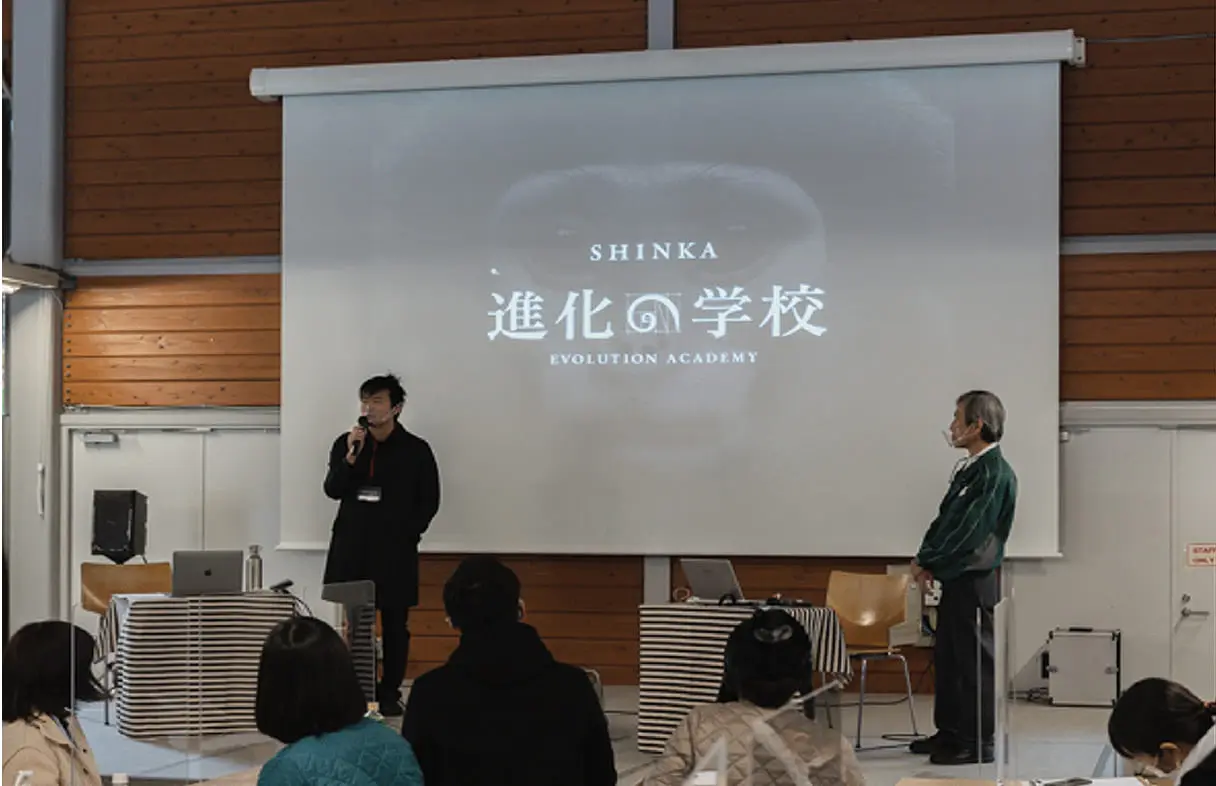
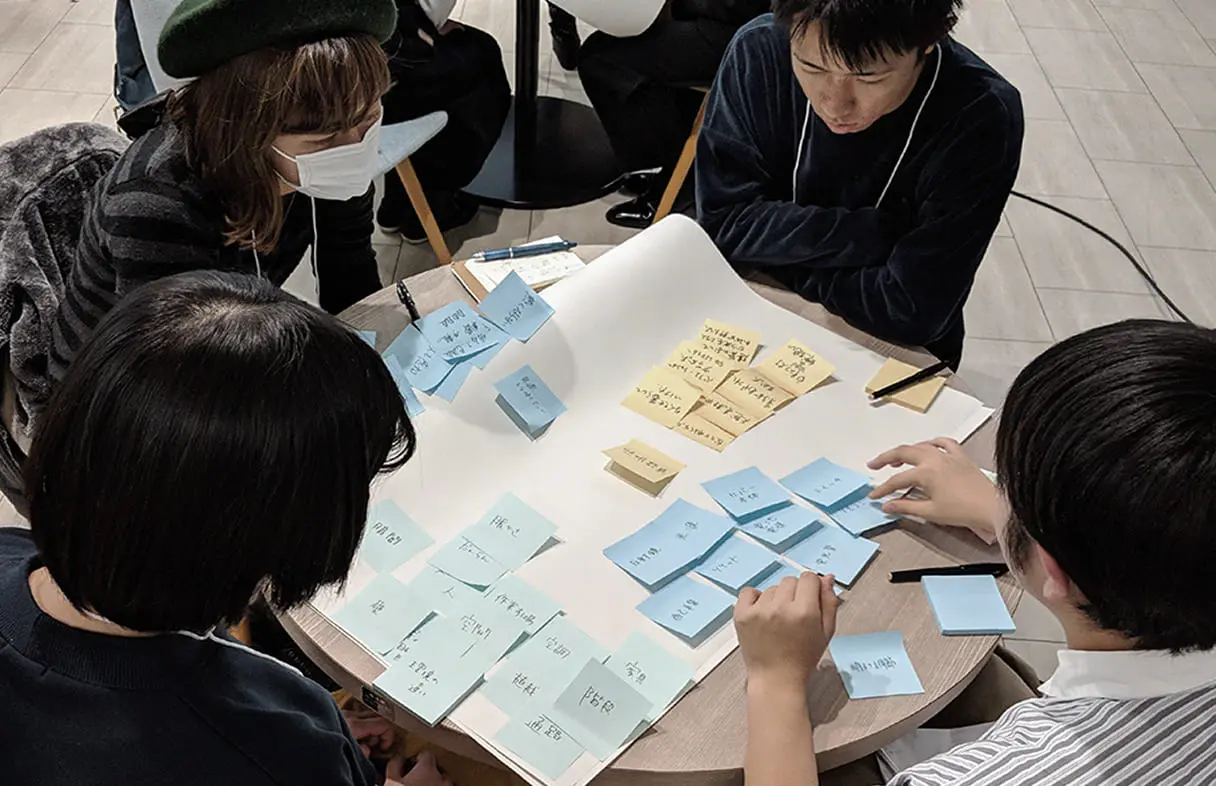
An online course was launched through the voluntary efforts of Takashi Yamada and other members who had studied Evolutional Creativity. The “School of Evolution” began as a course designed to plant the seeds of creativity across various sectors of society. This school is a training program that helps participants refine new ideas for business creation through lectures and workshops on Evolutional Creativity.
The “School of Evolution” has attracted a diverse group of participants, including corporate executives, employees aiming to drive innovation, and school teachers and public servants seeking to engage in creative practice. To date, the program has produced approximately 1,000 graduates.
The program is offered to a wide range of participants, from corporations and organizations to individuals, and is utilized for product development and human resource development. Many graduates continue to meet weekly to explore creativity education through Evolutional Creativity.
2019: Began writing the book *Evolutional Creativity*
After meeting Mr. Abe and Mr. Harada at “Kokuri! Camp,” they decided to launch the publishing house “Ami no Kaze” in Ami Town, Shimane Prefecture. They approached me with the idea of making *Evolutional Creativity* their first book, and thus began a three-year writing process.
September 2018: Paper on “Evolutional Creativity” Published in *DIAMOND Harvard Business Review*
A paper of approximately 10,000 characters summarizing the overview of “Evolutional Creativity” was published in
2018: Launch of the “Evolutional Creativity” Workshop
Having gained many insights through the exhibition, Tachikawa developed “The Grammar of Design” and launched “Evolutional Creativity,” a workshop designed to learn the creative process from biological evolution. At the first workshop held at “Cocri! Camp”—a gathering of leaders and experts from various sectors and fields—he met Takashi Yamada, who would later launch “The School of Evolution”; Yuji Abe, the publisher of *Evolutional Creativity*; and Eiji Harada of Eiji Publishing. Subsequently, the workshop was held at various companies, and “Evolutional Creativity” began to be adopted as an innovation methodology.
September 16–October 31, 2016: Exhibition “No-Designer: Form and Reason”
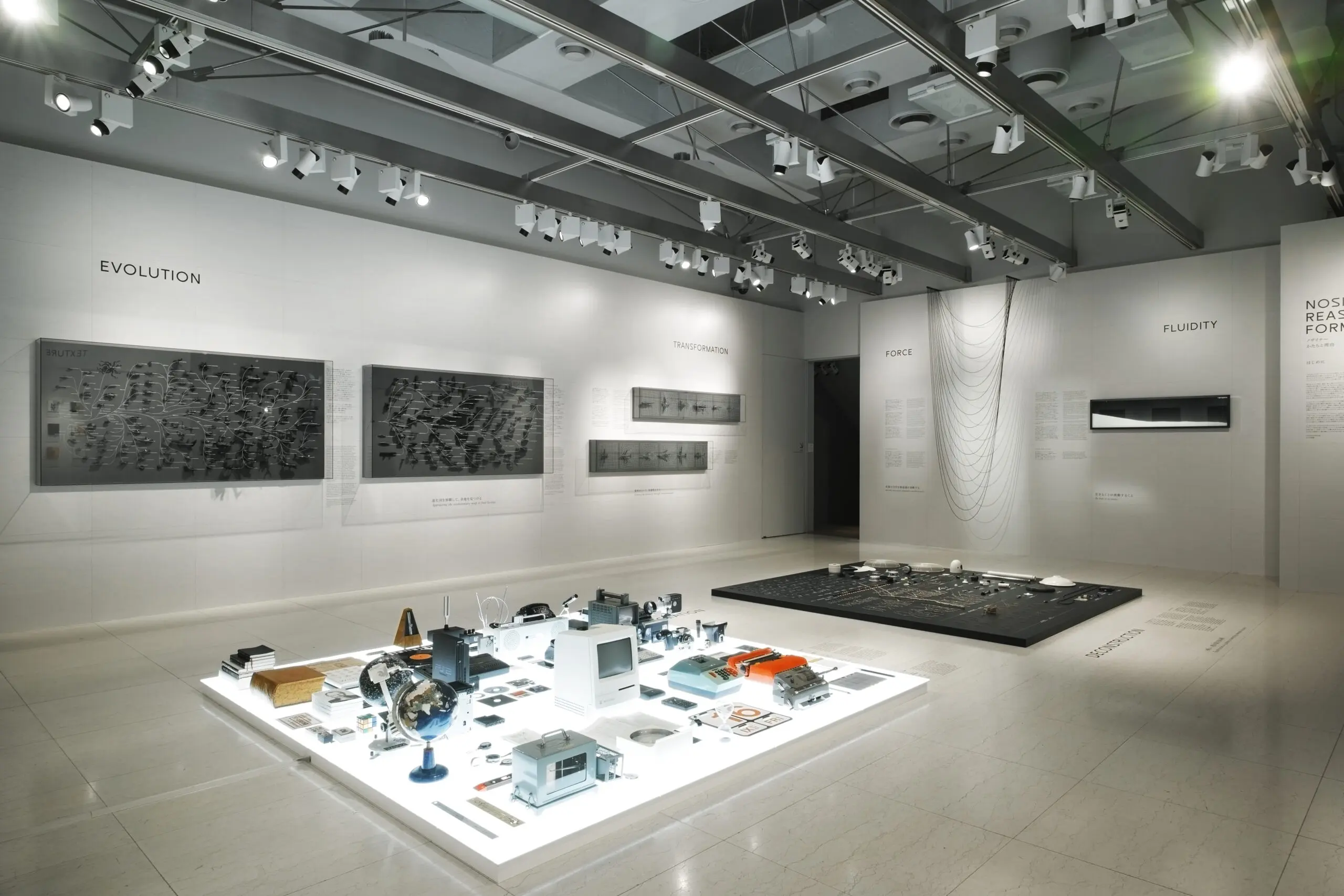
Tachikawa, who had become interested in the creativity of natural forms—which possess no language—that surpasses that of humans, began exploring the commonalities between biological evolution and human creativity. In the exhibition “No-Designer: Form and Reason,” held at the Ginza Graphic Gallery (ggg), he presented works that contrasted evolution and creation, delving into the reasons behind forms and methods for conceiving design.
2012 Began teaching the course “The Grammar of Design”
After entering the workforce and fully committing to his career as a designer, Tachikawa began teaching “The Grammar of Design” at Musashino Art University, a course that expanded upon the content of his master’s thesis. The course, which later expanded to include sessions for working professionals, gained a strong reputation, leading to its adoption at the University of Tokyo’s i.school and its application in innovation initiatives at various companies.
2006: Wrote Master’s Thesis “Linguistic Cognition of Design”
The origins of Evolutional Creativity lie in Tachikawa’s master’s thesis, “Linguistic Cognition of Design,” which he completed while studying architecture as a graduate student. Focusing on the process by which ideas and concepts emerge—a topic he had long been interested in—the thesis examined this process from a linguistic perspective, based on the assumption that language serves as the trigger for inspiration.

INFORMATION
- What
- Evolutional Creativity
- When
- 2016-
- Where
- Japan
- Scope
- Branding / Branding Strategy / Logo / Edition / Business card / Motion logo / Promotional items / Infographics / Photograph / Book cover and inner page design / Exhibition / Poster / Concept Development
- Award
- The 30th Shichihei Yamamoto Prize2021
- ITB GANESHA WIDYA JASA ADIUTAMA2024
- SDGs





CREDIT
- Inventor
- Eisuke Tachikawa
- Thanks
Amanokaze (kazetotuchito Inc. ),Eiji Press Inc. , NOSIGNER staffs,Ginza Graphic Gallery , Yuichi Hisatsugu, Kunihiko Sato